

BPC-157 vs TB-500: What Does Current Regenerative Research Show About Tissue Repair Mechanisms?
BPC-157 and TB-500 are frequently discussed in preclinical research contexts due to their association with biological processes involved in tissue repair systems, cellular signaling, and regenerative pathway modeling. However, in modern scientific literature, these compounds are not viewed as direct equivalents. Instead, they represent two distinct biological research categories with different mechanistic focuses. The comparison between BPC-157 and TB-500 is primarily driven by their relevance in: This article strictly focuses on biochemical mechanisms and laboratory-based interpretations of signaling pathways in preclinical research models. Explore research-grade peptide information and product listings at Pure Peptides UK. WHAT IS BPC-157 IN RESEARCH MODELS? BPC-157 is studied in preclinical research as a synthetic peptide fragment derived from a protective protein sequence found in gastric tissue-related biological systems. In laboratory environments, BPC-157 is primarily analyzed for its involvement in: Mechanistic Focus of BPC-157 Research interest is centered on how it may influence: Its scientific value lies in its stability in laboratory conditions and its consistent behavior in preclinical models used to study regenerative biology. WHAT IS TB-500 IN RESEARCH MODELS? TB-500 is a synthetic peptide associated with thymosin beta-4-related research pathways. It is studied in laboratory environments for its potential role in cellular migration and
Retatrutide Peptide UK: Research Overview & Legal Status
Retatrutide is a next-generation research peptide that has gained attention in scientific communities for its interaction with multiple receptor pathways. In laboratory environments, it is being studied for its complex mechanism and potential applications in metabolic research models. As interest grows, researchers and institutions in the UK are increasingly exploring its structural and functional properties under controlled conditions. Quick Facts What Is Retatrutide? Retatrutide is a synthetic peptide classified as a multi-receptor agonist, designed to interact with several biological pathways simultaneously. Unlike single-target peptides, it is structured to engage with multiple receptor types, making it a subject of interest in advanced laboratory studies. In research settings, compounds like retatrutide are typically analyzed to better understand how complex biological systems respond to multi-pathway stimulation. This allows researchers to observe interactions at a deeper level compared to traditional single-pathway compounds. The peptide belongs to a newer category of engineered compounds that are designed for experimental analysis rather than direct application. Because of this, it is strictly handled within laboratory environments and distributed for research purposes only. Chemical Structure & Classification Retatrutide is categorized as a synthetic peptide with a modified amino acid sequence engineered to enhance stability and receptor interaction. Its structure
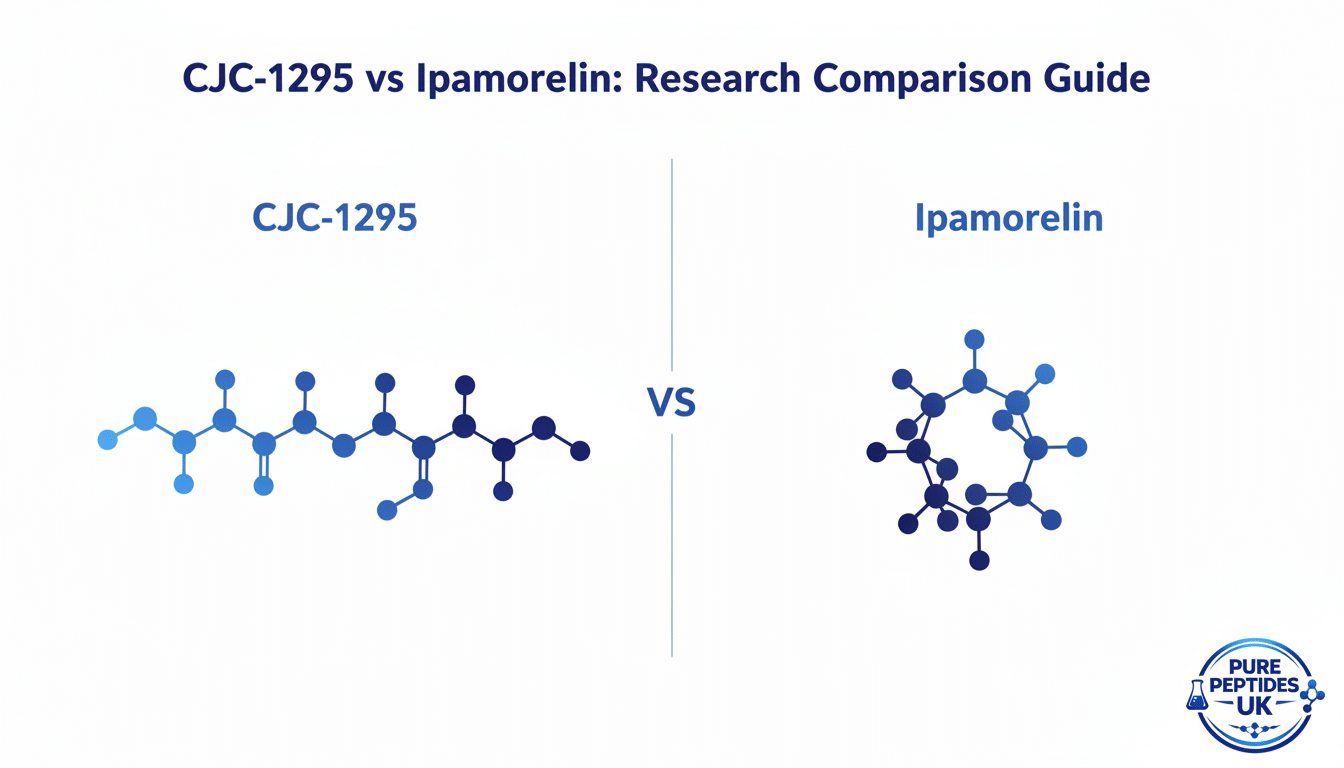
CJC-1295 vs Ipamorelin: Research Comparison Guide
CJC-1295 and Ipamorelin are two widely studied research peptides that are often analyzed together in laboratory settings due to their interaction with growth-related signaling pathways. Within controlled research environments, these compounds are examined for how they influence hormone signaling mechanisms and receptor activity. In the UK and globally, both peptides are commonly referenced in scientific discussions focused on peptide-based research models. While they are frequently mentioned together, their structure, mechanism, and research applications differ in several key ways. Quick Overview Feature CJC-1295 Ipamorelin Type Synthetic peptide Synthetic peptide Research Focus Hormone signaling pathways Receptor-specific signaling Mechanism Style Long-acting analog Selective receptor interaction Usage Research only Research only What Is CJC-1295? CJC-1295 is a synthetic peptide designed for research purposes, often studied for its role in signaling pathways related to growth hormone regulation. It is classified as a long-acting analog, meaning it is structured to remain stable within controlled environments for extended observation periods. In laboratory research, CJC-1295 by pure peptides, is typically examined to understand how prolonged signaling stimulation may influence biological systems. Its extended activity makes it a useful compound for studying sustained receptor interaction over time. Researchers are particularly interested in how such peptides behave under controlled experimental
What Is BPC-157? Research Overview, Structure & Studies
Interest in BPC-157 has grown fast in research circles, especially among labs studying peptide-based compounds and cellular processes. This synthetic peptide is often discussed for its stability and unique structure, making it a topic of ongoing scientific exploration. It’s important to note that BPC-157 is strictly for research purposes only and not for human consumption. What Is BPC-157? BPC-157, short for Body Protection Compound-157, is a synthetic peptide made up of 15 amino acids. It is classified as a pentadecapeptide and is commonly studied in laboratory environments. The compound is derived from a sequence found in a naturally occurring protein, but the version used in research is fully synthesized. In scientific contexts, BPC-157 is treated as a research peptide rather than a therapeutic or medical product. Researchers explore its behavior in controlled settings to better understand how peptides interact with biological systems. Unlike pharmaceutical-grade compounds approved for human use, BPC-157 remains in the category of experimental research materials. This means it is used in preclinical studies, often involving cell cultures or animal models, rather than clinical applications. Chemical Structure & Key Properties Understanding the structure of BPC-157 is key to understanding why it draws attention in research. Molecular Composition BPC-157

Pure Peptides UK Discount Code – Get 10% OFF with PURE10
Looking for a working Pure Peptides UK discount code that actually applies at checkout? You’re in the right place. Right now, you can get 10% OFF instantly using the verified promo code below: 👉 Use Code: PURE10👉 Discount: 10% OFF Sitewide No tricks. No hidden conditions. Just direct savings on research-grade peptide supplies. But before you place your order, here’s everything you need to know to save more, avoid low-quality suppliers, and make smarter purchasing decisions in the UK. What Is Pure Peptides UK? Pure Peptides UK is an online supplier offering research-grade peptides designed for laboratory and scientific use. Researchers prefer UK-based suppliers for: However, the real value comes down to quality, testing, and consistency, not just location. How to Use Pure Peptides UK Discount Code (Step-by-Step) Applying the PURE10 discount code is simple and takes less than a minute: 💡 Tip: Make sure the code is entered correctly (no extra spaces) to avoid errors. Why People Search for Pure Peptides UK Promo Codes Research peptides are not cheap and for good reason. High-quality peptides require: Because of this, even a 10% discount can make a noticeable difference, especially for repeat buyers or bulk orders. That’s why keywords like:

How Research Peptides Are Used in Scientific Studies
Modern scientific research depends on precision tools. Research peptides are one of the most powerful tools used in laboratories today. They allow scientists to study how cells communicate, how proteins interact, and how biological systems respond under controlled conditions. When used correctly, research peptides help unlock complex biological processes without the need for large, unstable molecules. Unlike larger proteins, peptides are smaller, more stable, and easier to control in experiments. This makes them ideal for targeted laboratory studies. From molecular biology to biochemical analysis, research peptides play a key role in advancing scientific understanding. Why Research Peptides Matter in Modern Science Researchers rely on accuracy. Even small changes at the cellular level can lead to completely different outcomes. Research peptides provide a controlled way to study these changes. Here’s why they are widely used in scientific research: Because of these advantages, peptides in scientific research are used across multiple fields, including molecular biology, biochemistry, and experimental lab studies. Key Ways Research Peptides Are Used in Scientific Studies Studying Cell Signaling Pathways Cells communicate through complex signaling systems. These signals control how cells grow, respond, and adapt to their environment. Research peptides are often used to study these pathways in detail.