
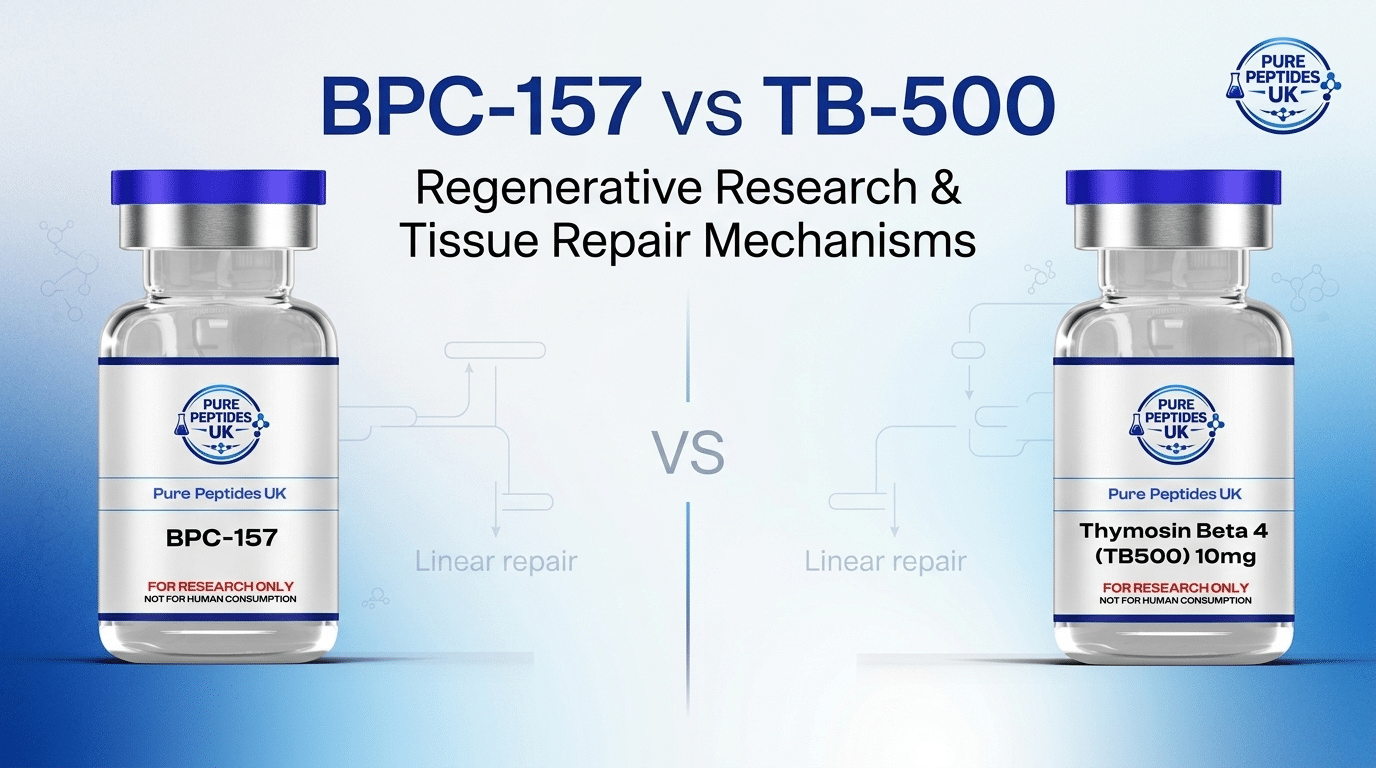
BPC-157 and TB-500 are frequently discussed in preclinical research contexts due to their association with biological processes involved in tissue repair systems, cellular signaling, and regenerative pathway modeling.
However, in modern scientific literature, these compounds are not viewed as direct equivalents. Instead, they represent two distinct biological research categories with different mechanistic focuses.
The comparison between BPC-157 and TB-500 is primarily driven by their relevance in:
- Cellular migration studies
- Angiogenesis research models
- Cytoskeletal organization research
- Wound-healing pathway simulations (preclinical)
This article strictly focuses on biochemical mechanisms and laboratory-based interpretations of signaling pathways in preclinical research models. Explore research-grade peptide information and product listings at Pure Peptides UK.
WHAT IS BPC-157 IN RESEARCH MODELS?
BPC-157 is studied in preclinical research as a synthetic peptide fragment derived from a protective protein sequence found in gastric tissue-related biological systems.
In laboratory environments, BPC-157 is primarily analyzed for its involvement in:
- Cellular signaling modulation
- Angiogenic pathway activity (formation of microvascular structures in models)
- Fibroblast behavior in tissue repair simulations
- Cytoprotective signaling responses in controlled experiments
Mechanistic Focus of BPC-157
Research interest is centered on how it may influence:
- Growth factor signaling cascades
- Endothelial cell communication
- Localized tissue response mechanisms in experimental systems
Its scientific value lies in its stability in laboratory conditions and its consistent behavior in preclinical models used to study regenerative biology.
WHAT IS TB-500 IN RESEARCH MODELS?
TB-500 is a synthetic peptide associated with thymosin beta-4-related research pathways. It is studied in laboratory environments for its potential role in cellular migration and structural tissue organization models.
In research settings, TB-500 is commonly associated with:
- Actin-binding protein pathway studies
- Cellular motility and migration models
- Tissue remodeling simulations in preclinical research
- Inflammatory response modulation pathways (experimental)
Mechanistic Focus of TB-500
TB-500 is often examined in the context of cytoskeletal dynamics, particularly how cells organize internal structural proteins that influence movement and spatial organization.
Key research areas include:
- Actin filament regulation studies
- Cellular repair simulation models
- Tissue regeneration pathway mapping in vitro
EARLY COMPARISON OVERVIEW: DIFFERENT BIOLOGICAL ROLES
Although BPC-157 and TB-500 are often mentioned together, their research functions differ significantly.
- BPC-157 is more frequently associated with vascular and endothelial signaling models
- TB-500 is more associated with cellular migration and cytoskeletal organization models
This distinction is important because it shows that both compounds operate in different biological domains rather than overlapping mechanisms.
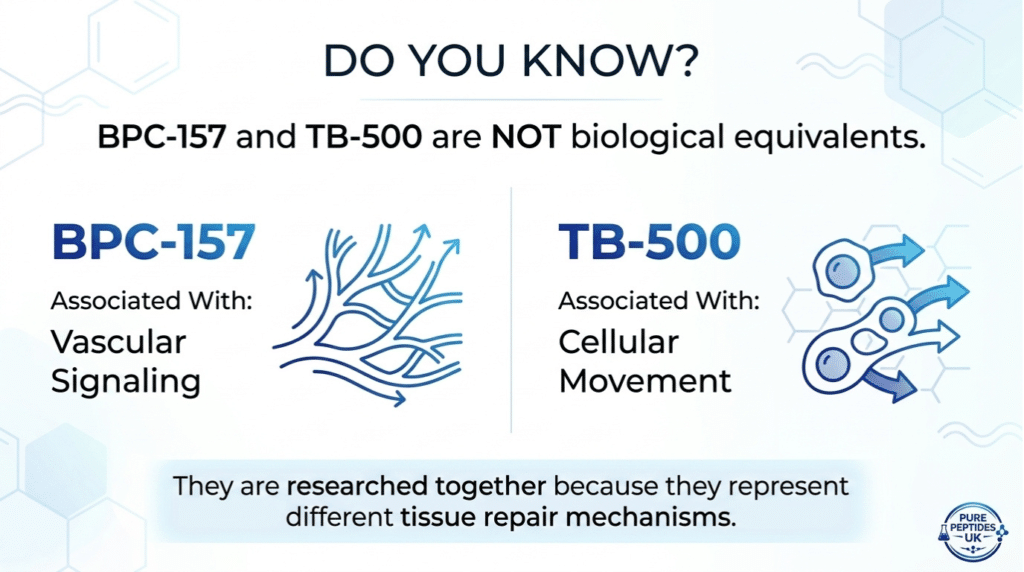
TABLE 1: HIGH-LEVEL RESEARCH COMPARISON
| Feature | BPC-157 | TB-500 |
| Primary Research Focus | Angiogenesis and endothelial signaling | Cellular migration and cytoskeletal structure |
| Biological System Emphasis | Vascular response modeling | Cell motility and tissue organization |
| Research Category | Protective signaling peptide model | Structural protein pathway model |
| Experimental Use | Endothelial and fibroblast studies | Actin dynamics and migration studies |
| Mechanistic Scope | Localized signaling networks | Broad cellular movement systems |
WHY RESEARCHERS STUDY THESE TWO COMPOUNDS TOGETHER
The comparison between BPC-157 and TB-500 is based on their complementary roles in regenerative biology research themes.
Modern preclinical studies examine both compounds in parallel because they represent different biological systems:
- One focused on vascular signaling and microcirculation behavior
- Another focused on structural cell movement and tissue organization
This allows researchers to build multi-layered models of tissue repair biology.
ANGIOGENESIS VS CELL MIGRATION: CORE MECHANISTIC DIFFERENCE
BPC-157 and Angiogenic Signaling Models
BPC-157 is often associated with endothelial behavior and microvascular formation models in laboratory settings.
TB-500 and Cellular Migration Models
TB-500 is primarily linked to cytoskeletal reorganization studies involving cell movement and structural adaptation.
DEEP MECHANISTIC COMPARISON: SIGNALING PATHWAYS AND BIOLOGICAL FUNCTIONALITY
Understanding the distinction between BPC-157 and TB-500 requires moving beyond surface-level categorization and focusing on how each compound is interpreted within modern preclinical signaling frameworks.
In current biological research, peptides are evaluated as modulators within larger systems involving intracellular signaling, extracellular communication, and tissue-level biological responses.
Within this framework, BPC-157 and TB-500 operate in two distinct mechanistic domains.
BPC-157: ENDOTHELIAL SIGNALING AND VASCULAR RESPONSE MODELS
BPC-157 is primarily studied in endothelial-focused research systems where the emphasis is on vascular communication, microenvironment stability, and localized cellular signaling behavior.
In preclinical models, BPC-157 is associated with:
- Endothelial cell signaling modulation
- Angiogenesis-related pathway activity in controlled laboratory models
- Growth factor communication networks
- Tissue microenvironment stabilization in experimental conditions
Functional Interpretation
BPC-157 is analyzed in localized biological contexts where vascular structures and endothelial responses are the primary focus.
Its research significance lies in how it behaves in controlled environments where microvascular signaling is being evaluated as part of regenerative modeling systems.
TB-500: CYTOSKELETAL ORGANIZATION AND CELLULAR MIGRATION MODELS
TB-500 is primarily associated with cytoskeletal dynamics and actin-regulation systems within cellular biology research.
The cytoskeleton is a structural framework within cells that controls shape, movement, and internal organization.
In preclinical studies, TB-500 is commonly linked to:
- Actin filament remodeling pathways
- Cellular migration and motility models
- Structural adaptation of cells in experimental systems
- Tissue organization simulation studies
Functional Interpretation
TB-500 is studied as part of structural cellular behavior rather than signaling initiation.
Its importance lies in how cells reorganize internally and physically respond during biological modeling processes.
FUNCTIONAL DIFFERENCE SUMMARY: TWO DISTINCT BIOLOGICAL DOMAINS
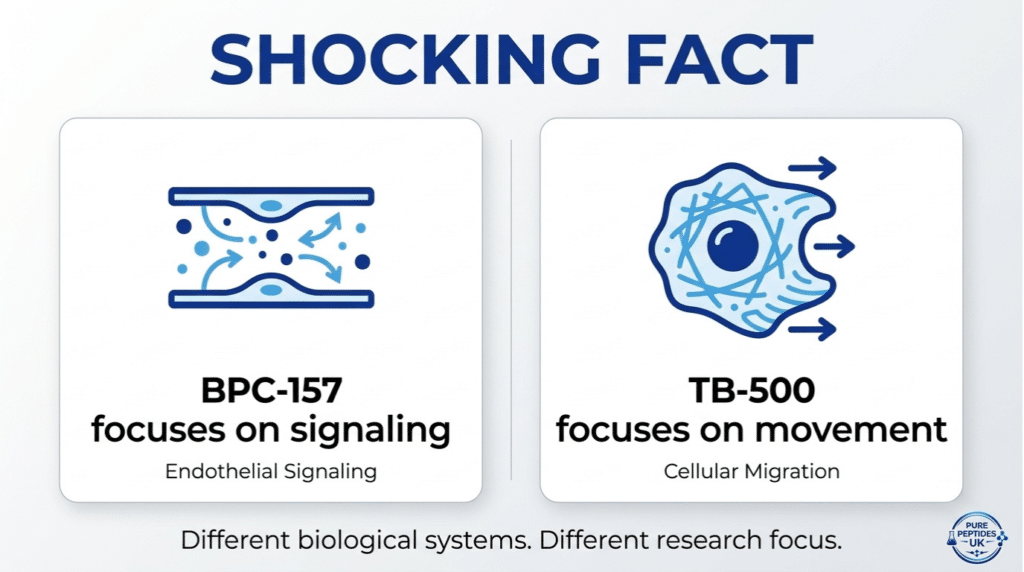
Although BPC-157 and TB-500 are frequently grouped in regenerative biology discussions, their roles are fundamentally different.
- BPC-157 is associated with vascular communication systems and endothelial signaling
- TB-500 is associated with structural cellular organization and movement systems
This distinction supports multi-layer biological modeling in regenerative research.
TABLE 2: DEEP MECHANISTIC COMPARISON
| Category | BPC-157 | TB-500 |
| Biological Domain | Endothelial and vascular signaling | Cytoskeletal and structural biology |
| Primary Focus | Microvascular communication systems | Cellular movement and organization |
| Mechanistic Role | Localized signaling modulation | Structural protein regulation |
| Research Emphasis | Angiogenesis-related pathways | Actin-driven migration systems |
| Experimental Context | Endothelial tissue models | Cytoskeletal remodeling models |
WHY THESE DIFFERENCES MATTER IN MODERN RESEARCH
Modern regenerative biology now uses systems-level modeling instead of single-pathway interpretation.
Biological repair is studied as an interaction of:
- Vascular signaling networks
- Cellular structural systems
- Extracellular communication environments
BPC-157 and TB-500 represent different layers of this biological system.
FREQUENTLY ASKED QUESTIONS
What is the main difference between BPC-157 and TB-500?
BPC-157 is associated with endothelial signaling systems, while TB-500 is associated with cytoskeletal structure and cellular migration systems.
Why are they compared in research?
They represent different layers of regenerative biology modeling.
Does this article suggest medical use?
No. This is strictly educational and research-based content.
What is TB-500 mainly associated with?
Actin dynamics and structural cellular organization.
What is BPC-157 mainly associated with?
Endothelial signaling and vascular communication models.
DESCLAIMER
This content is strictly for educational and scientific research purposes only. The compounds discussed are for laboratory research use only and are not approved for human consumption, medical treatment, or therapeutic applications.
References:
- “The Role of BPC-157 in Tissue Repair and Pain Management.” PubMed, 21 Mar. 2026, pubmed.ncbi.nlm.nih.gov/41898733/.pubmed.ncbi.nlm.nih
- “Local and Systemic Peptide Therapies for Soft Tissue Regeneration.” PMC, 29 Sept. 2024, pmc.ncbi.nlm.nih.gov/articles/PMC11426299/.pmc.ncbi.nlm.nih
- Sikiric, P., et al. “Gastric Pentadecapeptide Body Protection Compound BPC 157 and Its Role in Tissue Healing.” Current Pharmaceutical Design, 2019. PubMed, pubmed.ncbi.nlm.nih.gov/30915550/.pubmed.ncbi.nlm.nih
- Sikiric, P., et al. “Therapeutic Potential of Pro-Angiogenic BPC157 Is Associated with the VEGFR2-Akt-eNOS Signaling Pathway.” PubMed, 2 Mar. 2017, pubmed.ncbi.nlm.nih.gov/27847966/.pubmed.ncbi.nlm.nih
- Černková, M., et al. “Modulatory Effects of BPC 157 on Vasomotor Tone and the Activation of the Src-Cav-1-eNOS Signaling Pathway.” Scientific Reports, 2020, www.nature.com/articles/s41598-020-74022-y.nature
- “Modulatory Effects of BPC 157 on Vasomotor Tone and the Activation of the Src-Cav-1-eNOS Signal Pathway.” ADS Abstract Service, 2020, ui.adsabs.harvard.edu/abs/2020NatSR..1017078H/abstract.adsabs.harvard
- Goldstein, A. L., and M. S. Zagon. “Thymosin β4: A Multi-Functional Regenerative Peptide.” Annals of the New York Academy of Sciences, 2012, pubmed.ncbi.nlm.nih.gov/22074294/.pubmed.ncbi.nlm.nih
- “Thymosin Beta-4 – an Overview.” ScienceDirect Topics, Elsevier, www.sciencedirect.com/topics/biochemistry-genetics-and-molecular-biology/thymosin-beta-4.sciencedirect
- “What Are Thymosin Beta 4 Agonists and How Do They Work?” Patsnap Synapse, 24 June 2024, synapse.patsnap.com/article/what-are-thymosin-beta-4-agonists-and-how-do-they-work.synapse.patsnap
- “TB-500 Peptide | Healing & Flexibility.” Paragon Sports Medicine, accessed 23 May 2026, www.paragonsportsmedicine.com/peptides/tb-500. paragonsportsmedicine
- “Peptides for Tissue Repair: BPC-157, TB-500 & the ‘Wolverine Stack.’” Mind and Matter, 21 Mar. 2026, mindandmatter.substack.com/p/peptides-for-tissue-repair-bpc-157.mindandmatter.substack
- “BPC 157 and Cardiovascular Research: Angiogenesis, Vascular Biology and Cardiac Protection.” Peptides Lab UK, 11 Apr. 2026, peptideslabuk.com/bpc-157-and-cardiovascular-research-angiogenesis-vascular-biology-and-cardiac-protection-uk-2026/.peptideslabuk