
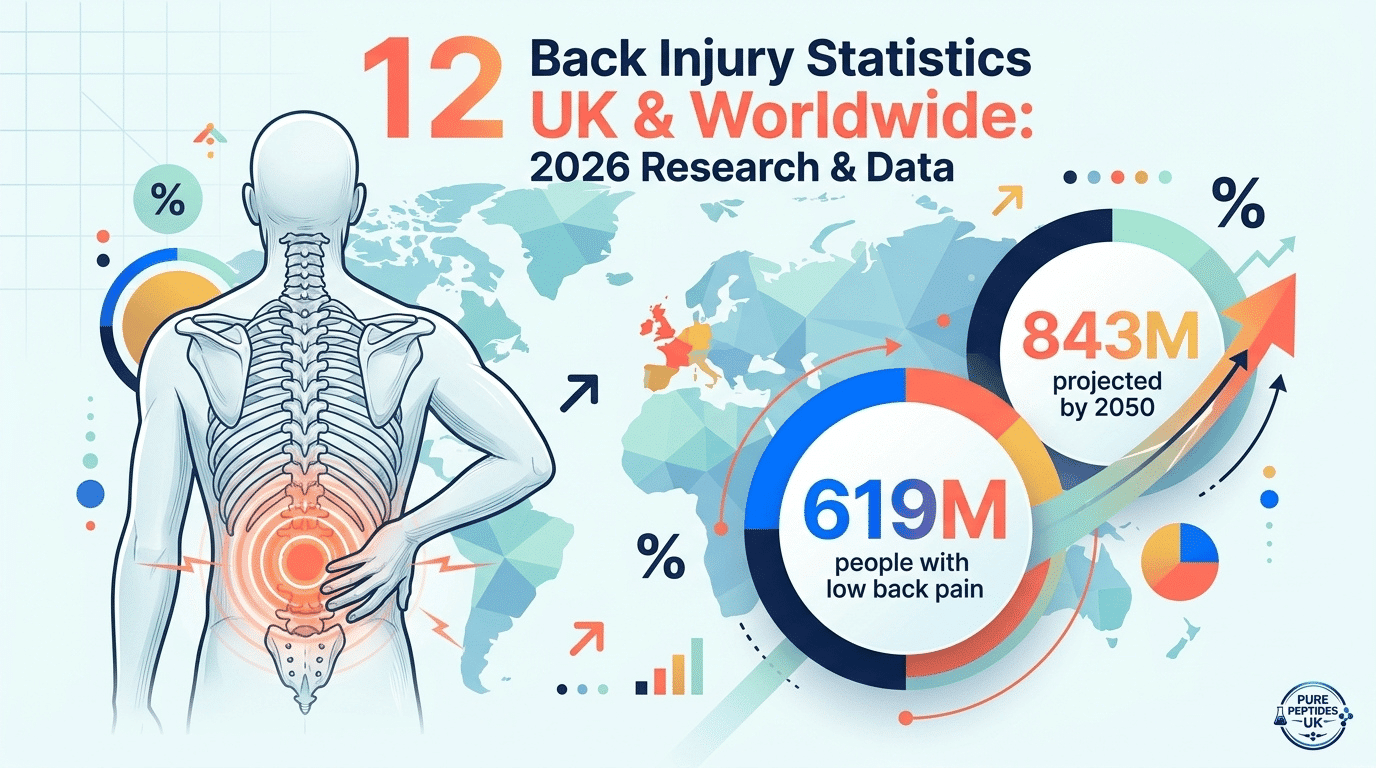
Back problems are among the most common musculoskeletal health issues affecting people at work and in everyday life. They can range from short-term discomfort after physical exertion to persistent low back pain that affects mobility, work, sleep and quality of life.
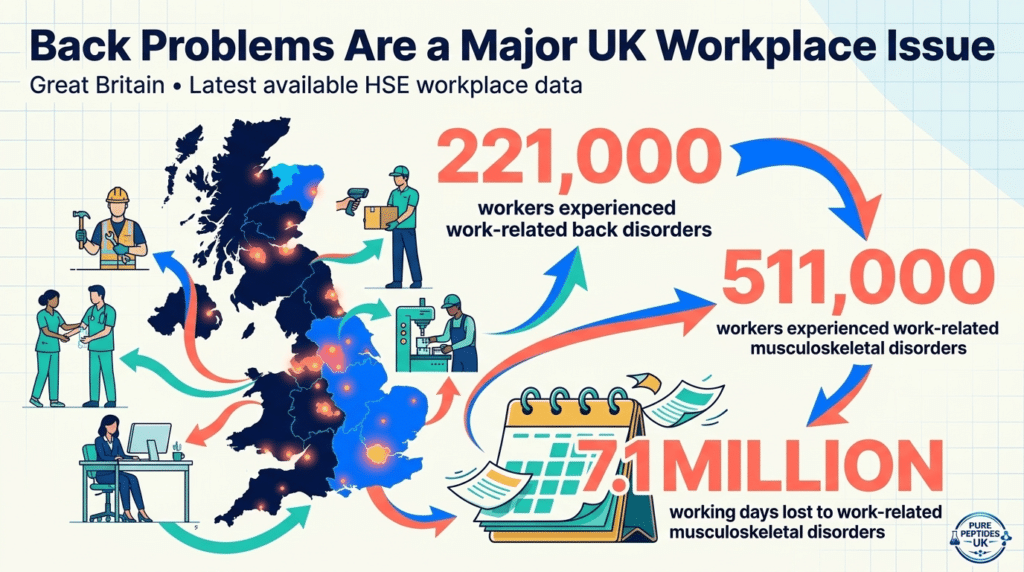
The latest UK data shows that back disorders remain a major part of the country’s work-related musculoskeletal burden. In Great Britain, an estimated 511,000 workers experienced a work-related musculoskeletal disorder in 2024/25, and 221,000 of those cases involved the back. At the global level, the World Health Organization estimates that 619 million people experienced low back pain in 2020, making it the world’s leading cause of disability.
However, statistics about back injuries can be difficult to interpret because researchers do not always measure the same thing. A workplace study may count work-related musculoskeletal disorders, while a population health survey may measure chronic pain or low back pain. These figures should not automatically be treated as interchangeable.
This guide brings together the latest available UK and worldwide evidence and explains what the numbers actually mean. The UK figures are primarily based on data from organisations such as the Health and Safety Executive (HSE), Office for National Statistics (ONS), and NHS England, while global figures draw on WHO research and international disease-burden estimates.
Data note: This article was updated in 2026, but the statistics are labelled according to the year of the underlying dataset. This avoids presenting older survey data as if it were collected in 2026.
12 Back Injury Statistics at a Glance
Here are the key figures covered throughout the article:
| # | Back Injury Statistic | Latest Available Data |
| 1 | UK workers with work-related back disorders | 221,000 |
| 2 | UK workers with work-related musculoskeletal disorders | 511,000 |
| 3 | Share of work-related ill health represented by MSDs | 27% |
| 4 | Working days lost because of work-related MSDs | 7.1 million |
| 5 | Share of work-related ill-health working days linked to MSDs | 20% |
| 6 | UK workers with a work-related illness | 1.9 million |
| 7 | MSK share of UK sickness-absence occurrences | 14.6% |
| 8 | People worldwide experiencing low back pain | 619 million |
| 9 | Projected global cases by 2050 | 843 million |
| 10 | Global disability ranking of low back pain | #1 |
| 11 | Non-specific low back pain | Around 90% |
| 12 | Global disability burden from low back pain | 8.1% of YLDs |
The first six statistics focus heavily on the UK workplace picture. The remaining figures broaden the discussion to population health and the worldwide burden of low back pain.
1. Around 221,000 UK Workers Experienced Work-Related Back Disorders
The latest HSE statistics provide one of the clearest measures of the scale of workplace back problems in Great Britain.
In 2024/25, around 221,000 workers were affected by work-related disorders mainly involving the back. HSE reports that this represented approximately 43% of all work-related musculoskeletal disorder cases, making the back the largest affected body area in its breakdown.
This is an important distinction. The figure does not mean that 221,000 people suffered a sudden accident such as a lifting injury during the year. HSE’s work-related musculoskeletal statistics include both new and long-standing disorders that workers associate with their current or most recent job.
That makes the statistic particularly useful when discussing occupational back pain. Workplace back problems can develop gradually through repeated physical demands rather than appearing after one clearly identifiable incident.
The HSE data also shows that the back accounted for a larger share of work-related MSD cases than either the upper limbs and neck or lower limbs. Around 211,000 cases involved the upper limbs or neck, while approximately 78,000 involved the lower limbs.
Why this UK back injury statistic matters
The figure highlights why back health remains an important occupational health issue. Jobs involving physical workloads, repetitive movements, manual handling or awkward working positions can place continuing demands on the musculoskeletal system.
It also shows why simply counting workplace accidents does not give the full picture. Some back disorders develop over time and may not appear in traditional accident statistics.
2. Around 511,000 UK Workers Experienced a Work-Related Musculoskeletal Disorder
Back disorders form part of a much wider category known as work-related musculoskeletal disorders, or MSDs.
According to the HSE’s latest figures, approximately 511,000 workers in Great Britain were suffering from a work-related musculoskeletal disorder during 2024/25. This includes both new and long-standing cases.
The category covers problems affecting different parts of the body, including the back, neck, upper limbs and lower limbs. It therefore provides a broader picture than back injury statistics alone.
Of the estimated 511,000 workers:
- 221,000 involved the back
- 211,000 involved the upper limbs or neck
- 78,000 involved the lower limbs
The estimates do not add perfectly to 511,000 because of rounding and because some workers may have more than one affected area.
Back disorders are the largest reported body-area category
The fact that back disorders represent the largest share of these work-related MSD cases is significant.
It also challenges the idea that workplace musculoskeletal problems are only associated with heavy manual labour. Different occupations can expose workers to different physical demands. A warehouse worker may experience repeated lifting and carrying, while another worker may spend long periods in a fixed or poorly designed working position.
The important point is that work-related musculoskeletal disorders are a broad occupational health category, and back disorders are one of its most prominent components.
3. Musculoskeletal Disorders Account for About 27% of UK Work-Related Ill Health
Musculoskeletal disorders are not a small part of the UK’s workplace health picture.
HSE estimates that MSDs accounted for approximately 27% of all work-related ill health in Great Britain in 2024/25. That places them behind stress, depression and anxiety but ahead of the broader group of other work-related health conditions.
Across all types of work-related ill health, HSE estimated that around 1.9 million working people were suffering from a work-related illness in 2024/25. MSDs therefore represent a substantial portion of the overall occupational health burden.
It is worth being careful with the wording here.
The statistic does not mean that 27% of British workers have a musculoskeletal disorder. It means that MSDs represented approximately 27% of reported work-related ill-health cases within the HSE dataset.
That difference may seem minor, but it is important when interpreting health statistics.
What counts as a musculoskeletal disorder?
Musculoskeletal disorders can involve muscles, joints, tendons, ligaments and other structures involved in movement. In workplace statistics, they can include conditions affecting the back, neck, arms, shoulders and legs.
For this reason, musculoskeletal disorder statistics and back injury statistics are related but not identical.
A good back injury article needs to make that distinction clear rather than treating every MSD as a back injury.
4. Work-Related Musculoskeletal Disorders Caused 7.1 Million Lost Working Days
The impact of work-related back and musculoskeletal problems is not limited to the number of workers affected.
HSE estimates that work-related musculoskeletal disorders resulted in approximately 7.1 million working days lost in Great Britain during 2024/25.
This figure illustrates why workplace back problems are also a productivity issue.
When a worker develops a musculoskeletal condition, the consequences can include:
- Time away from work
- Reduced ability to perform physical tasks
- Changes to normal duties
- Reduced productivity
- Longer recovery periods
- Pressure on colleagues covering absent workers
The statistics also demonstrate why a single injury count does not fully describe the burden of back problems. Two conditions may involve the same number of workers but have very different effects on working time.
Why working days lost are important
Working-days-lost data provides another way to understand the impact of musculoskeletal disorders. It captures the effect on the workplace rather than simply counting people who report a condition.
HSE’s figures show that MSDs continue to generate millions of lost working days every year, even though the long-term pattern has changed over time. The latest three years have been broadly similar to the pre-coronavirus 2018/19 level, suggesting that the earlier downward trend in MSD rates has not continued.
For businesses, that makes prevention, workplace design and appropriate risk management important parts of occupational health planning.
5. Musculoskeletal Disorders Account for About 20% of Work-Related Ill-Health Working Days Lost
The scale of lost working time becomes even clearer when MSDs are considered as a proportion of all working days lost because of work-related ill health.
HSE data indicates that work-related musculoskeletal disorders accounted for approximately 20% of working days lost due to work-related ill health in 2024/25.
This is different from saying that MSDs caused 20% of every working day lost from any form of sickness or injury.
The HSE figure relates specifically to working days lost because of work-related ill health.
That distinction matters because overall sickness absence statistics cover a much wider range of health conditions.
Back pain and workplace productivity
Back problems can affect productivity even when a worker does not take formal sick leave. Someone may continue working while experiencing pain but have difficulty with lifting, bending, standing, walking or maintaining a normal pace.
This is one reason why absence figures should not be treated as the complete measure of the burden of back pain.
A worker who remains at work while struggling with a musculoskeletal problem may not appear in a simple “days off work” statistic, even though the condition can still affect their ability to perform their normal duties.
6. Around 1.9 Million UK Workers Experienced a Work-Related Illness
The UK’s workplace health burden extends well beyond back problems.
HSE estimated that approximately 1.9 million working people were suffering from a work-related illness in Great Britain during 2024/25. This includes both new and long-standing cases.
Within this total, around 511,000 workers were affected by work-related musculoskeletal disorders. That places MSDs among the largest categories of work-related ill health in Great Britain.
The broader figure is useful because it puts workplace back disorders into context.
Work-related ill health can involve:
- Musculoskeletal disorders
- Stress, depression and anxiety
- Respiratory conditions
- Skin conditions
- Hearing-related conditions
- Other occupational diseases
Back problems therefore represent one important component of a much larger workplace health picture.
Why the distinction between injury and illness matters
The words “back injury” and “work-related back disorder” are sometimes used interchangeably online, but they can describe different things.
A sudden injury might happen while lifting an object or during an accident. A work-related disorder can also develop gradually as a result of repeated physical demands.
The HSE statistics are designed to capture this wider occupational burden rather than only sudden accidents.
That makes them particularly useful for understanding the real scale of work-related back problems in Britain.
A Note on the Latest UK Sickness-Absence Data
Another useful source for understanding the UK picture is the Office for National Statistics.
The latest ONS Sickness Absence in the UK Labour Market: 2025 publication, released in May 2026, estimates that 148.8 million working days were lost because of sickness or injury in the UK during 2025. The overall sickness-absence rate was 2.0%.
ONS uses a different methodology from HSE, so its figures should not be directly combined with HSE’s workplace-ill-health totals.
This is an important point when researching back injury statistics: different official datasets answer different questions.
HSE is particularly useful for work-related ill health and occupational MSDs in Great Britain. ONS provides a broader view of sickness absence across the UK labour market.
That distinction helps prevent misleading comparisons and gives a clearer picture of how back and musculoskeletal problems fit into the wider health and employment landscape.
What These UK Statistics Tell Us So Far
The latest UK evidence points to several clear conclusions.
First, back disorders remain the largest affected body-area category within work-related musculoskeletal disorders, with around 221,000 workers affected in 2024/25.
Second, the wider musculoskeletal burden is much larger, affecting approximately 511,000 workers and contributing to 7.1 million lost working days.
Third, these numbers should not be interpreted as simple counts of acute workplace accidents. HSE’s data includes new and long-standing work-related disorders, which means it captures a broader range of occupational musculoskeletal problems.
Finally, the UK workplace picture is only part of the story. Back pain is also a major global health issue, affecting hundreds of millions of people outside the workplace.
7. Musculoskeletal Problems Accounted for 14.6% of UK Sickness-Absence Occurrences in 2025
The latest Office for National Statistics data provides another useful measure of the UK’s musculoskeletal burden.
In 2025, musculoskeletal problems accounted for 14.6% of sickness-absence occurrences in the UK. The ONS category includes back pain, neck and upper-limb problems, and other musculoskeletal problems.
This statistic is different from the HSE figures discussed earlier. HSE focuses on work-related ill health and occupational musculoskeletal disorders, while ONS measures sickness absence across the UK labour market.
That means the 14.6% figure should not be interpreted as saying that 14.6% of UK workers had a back injury.
Instead, it means that musculoskeletal problems were given as the reason for approximately 14.6% of sickness-absence occurrences recorded in the ONS Labour Force Survey.
The distinction matters because musculoskeletal problems include more than back pain.
Why this is an important UK back pain statistic
The ONS data gives us a more recent view of sickness absence. Its 2025 release, published in May 2026, estimated that 148.8 million working days were lost because of sickness or injury across the UK, equal to an average of 4.4 days per worker.
Musculoskeletal conditions are therefore part of a much larger sickness-absence picture.
It is also worth noting that ONS describes these as official statistics in development and warns that recent Labour Force Survey estimates should be interpreted carefully because of changes to data collection and sampling.
That transparency is important when using current statistics in health content.
8. Around 619 Million People Worldwide Experienced Low Back Pain
The scale becomes much larger when we move from workplace statistics to global population health.
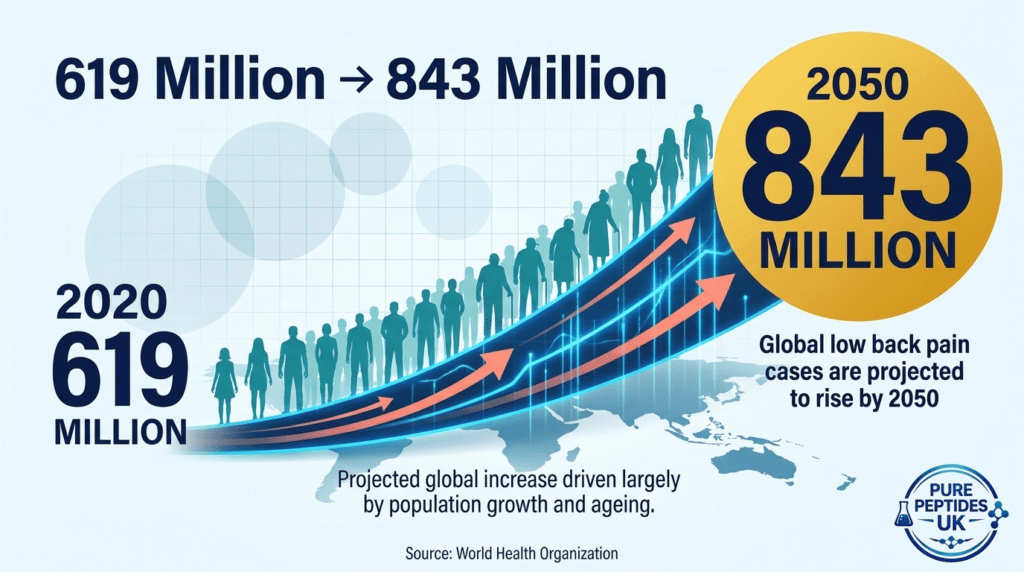
The World Health Organization estimates that 619 million people worldwide experienced low back pain in 2020. That is roughly one person in every 13 globally.
Low back pain is defined by WHO as pain between the lower edge of the ribs and the buttocks. It can be short-lived or persistent and can affect people at different ages.
The 619 million figure comes from global disease-burden research rather than a count of people who visited a doctor or reported a workplace injury.
That distinction is important.
Many people with low back pain may manage their symptoms without seeing a healthcare professional. Others may have recurrent symptoms over time. A global prevalence estimate attempts to capture the broader population burden rather than only diagnosed cases.
Why low back pain is such a significant global issue
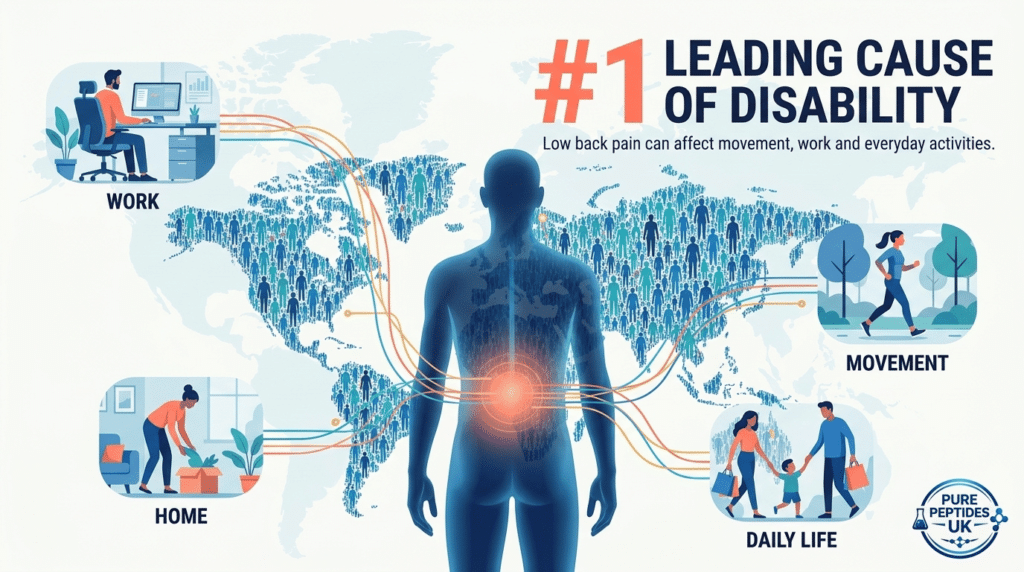
WHO identifies low back pain as the most prevalent musculoskeletal condition worldwide and the leading cause of disability globally.
It can affect everyday activities as well as employment. People experiencing persistent low back pain may have difficulty with movement, work activities and normal social or family activities.
The global figure also demonstrates why UK workplace statistics should not be mistaken for a measure of all back problems. Occupational data captures one specific part of the population burden, while global low back pain estimates cover people across different countries, ages and employment situations.
9. Global Low Back Pain Cases Are Projected to Reach 843 Million by 2050
The worldwide burden of low back pain is expected to increase substantially over the coming decades.
WHO estimates that the number of people experiencing low back pain could rise from 619 million in 2020 to approximately 843 million by 2050.
That is an increase of roughly 224 million cases.
Importantly, WHO attributes much of the projected increase to population growth and population ageing rather than suggesting that every individual’s personal risk will necessarily increase.
This is an important point when interpreting future back pain statistics.
A larger number of cases can result partly because there are more people overall and more people living into older age groups.
What could drive the increase?
Researchers have identified several factors relevant to the future burden of low back pain, including:
- Population growth
- Population ageing
- Increasing numbers of older adults
- Physical inactivity
- Obesity
- Smoking
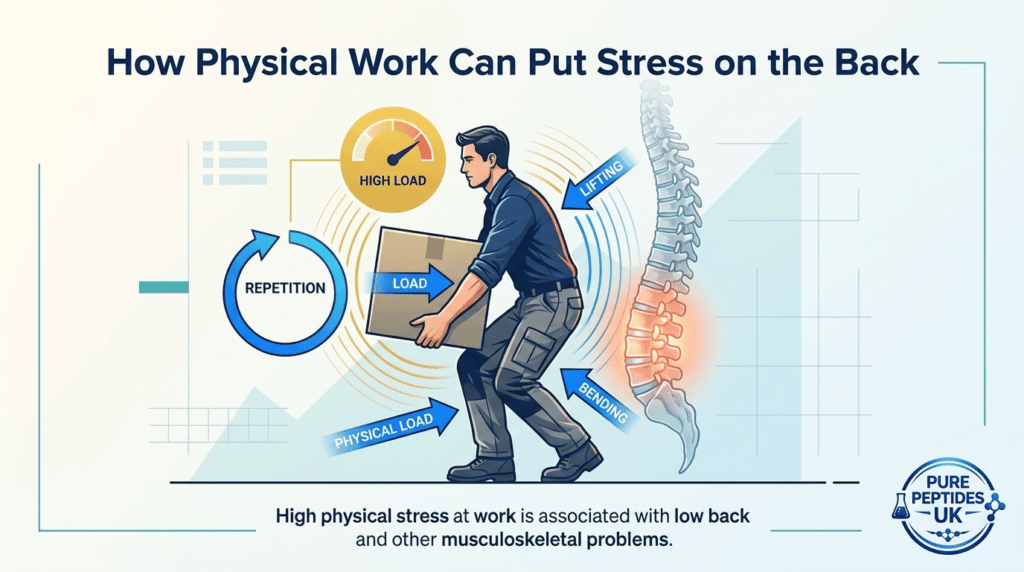
- Physical stress at work
WHO specifically identifies low physical activity, smoking, obesity and high physical stress at work among risk factors associated with non-specific low back pain.
The projected 843 million figure therefore represents a major challenge for healthcare systems, workplaces and rehabilitation services around the world.
10. Low Back Pain Is the World’s Leading Cause of Disability
Low back pain is not simply common. It has an exceptionally large effect on global disability.
WHO identifies low back pain as the single leading cause of disability worldwide.
This does not mean low back pain is the world’s leading cause of death, nor does it mean every person with back pain becomes disabled.
Instead, the statement refers to the amount of disability associated with the condition across the global population.
What does “disability” mean in this context?
In population health research, disability can include limitations in a person’s ability to perform normal activities because of a health condition.
For someone with low back pain, this could involve difficulty:
- Walking
- Standing
- Sitting
- Lifting
- Bending
- Working
- Participating in normal activities
The impact varies considerably between individuals.
Some episodes are brief and resolve without lasting effects. Others can persist or recur and have a much greater effect on daily life.
This is one reason why prevalence alone does not tell the complete story. Two health conditions can affect similar numbers of people but produce very different levels of disability.
11. Around 90% of Low Back Pain Is Classified as Non-Specific
One of the most misunderstood back pain statistics concerns the cause of low back pain.
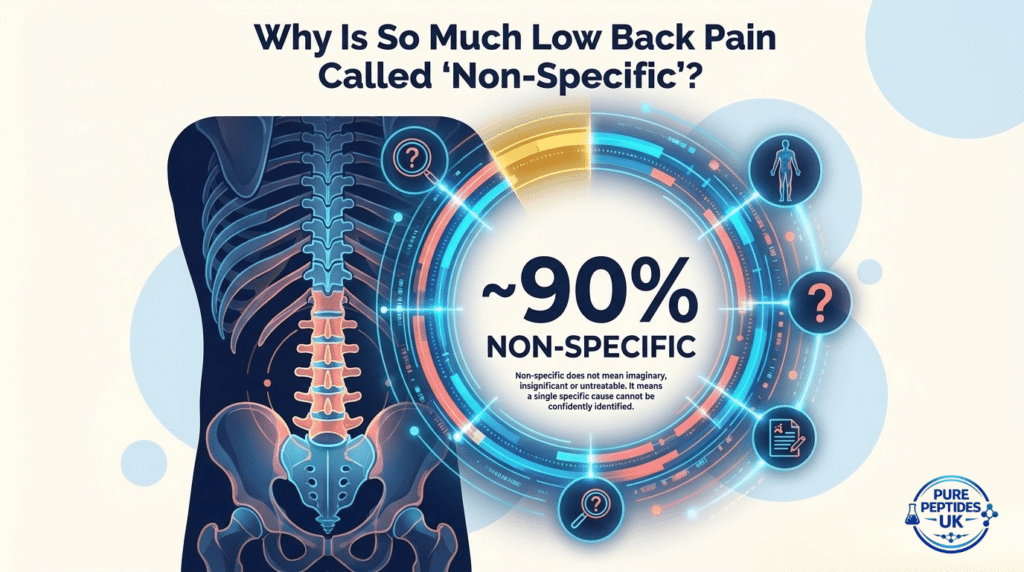
WHO reports that non-specific low back pain accounts for about 90% of cases.
Non-specific does not mean imaginary, minor or unimportant.
It means that a specific disease, structural problem or other identifiable diagnosis cannot confidently explain the person’s symptoms.
What is specific low back pain?
Specific low back pain can be linked to an identifiable underlying condition or problem. WHO gives examples that can include diseases, tissue damage or pain referred from another part of the body.
Non-specific low back pain is different because there may not be one clearly identifiable structural explanation.
This is an important distinction for anyone researching back injury causes.
A person can experience genuine pain and functional limitations without doctors being able to point to one specific structure as the cause.
Why the statistic matters
The 90% figure also shows why it can be misleading to describe all low back pain as a simple result of one injury mechanism.
Back pain can involve multiple physical, occupational and lifestyle factors. Research into low back pain therefore often looks at patterns of symptoms, function, risk factors and disability rather than searching for one universal cause.
12. Low Back Pain Creates a Major Global Disability Burden
The final statistic concerns years lived with disability, commonly abbreviated as YLDs.
YLDs are used in global health research to estimate the amount of healthy life affected by a condition. Rather than simply counting how many people have a disease, the measure considers both the number of people affected and the severity or disabling effect of the condition.
Global Burden of Disease research has consistently found that low back pain is a major contributor to years lived with disability worldwide, and the 2020 analysis confirms its position as the leading contributor among health conditions.
This is why the global burden of back pain cannot be measured adequately by counting injuries alone.
A person may never have a documented “back injury” but could still experience low back pain that limits their ability to work or participate in normal activities.
Why disability data matters
A useful back injury statistics article needs to consider three different questions:
How many people experience the condition?
This is prevalence.
How much work or activity does it affect?
This relates to functional limitation and productivity.
How much disability does it create across the population?
This is where measures such as YLDs become useful.
Together, these measurements provide a much more complete picture than a single injury count.
Back Injury Statistics in the UK vs Worldwide
UK and worldwide statistics are useful together, but they should not be directly compared as if they measure exactly the same thing.
| Measure | UK | Worldwide |
| Work-related back disorders | ~221,000 workers in Great Britain, 2024/25 | Not directly comparable |
| Work-related MSDs | ~511,000 workers in Great Britain, 2024/25 | Not directly comparable |
| MSK share of UK sickness absence | 14.6% of occurrences in 2025 | Not directly comparable |
| Low back pain | Population-specific estimates vary | 619 million people in 2020 |
| Projected low back pain cases | — | 843 million by 2050 |
| Disability burden | Significant occupational and health burden | Leading cause of disability |
The UK figures largely describe work-related disorders and sickness absence, while the global estimates describe population-level low back pain.
That difference is important.
A worker with back pain may appear in workplace statistics, but a retired person, student or unemployed individual with low back pain would not necessarily appear in occupational datasets.
How Common Is Chronic Pain in England?
The latest Health Survey for England 2024, published in January 2026, provides another useful perspective on the UK’s wider pain burden.
The survey found that 26% of adults in England reported chronic pain, defined in the survey as experiencing pain most days or every day within the previous three months. Around 13% reported high-impact chronic pain, meaning pain that interfered with life or work activities most days or every day.
Among adults who reported chronic pain, 52% identified back pain as one of their pain sites.
This needs to be interpreted carefully.
It does not mean that 52% of all adults in England have back pain.
Instead, the finding means that among people who reported chronic pain, just over half identified the back as a location of their pain.
That makes the survey particularly useful for understanding how frequently back pain appears alongside chronic pain in England.
Which Occupations Are Associated With Higher Back-Problem Risk?
Workplace back problems can occur across many occupations, but the physical demands of some jobs can increase exposure to musculoskeletal risk factors.
Examples include:
Construction and manual work
Construction workers can face repeated lifting, carrying, bending, kneeling and other physically demanding tasks.
Transport and storage
Workers involved in transportation, warehousing and logistics may regularly handle loads or spend long periods in physically demanding positions.
Healthcare and care work
Patient handling and other physically demanding tasks can place substantial demands on the musculoskeletal system.
Process, plant and machine operation
ONS reported that workers in process, plant and machine operative occupations had the highest overall sickness-absence rate among major occupation groups in 2025, at 3.3%. This figure covers all sickness absence rather than specifically measuring back injuries, so it should not be interpreted as a back-injury rate.
This distinction illustrates an important principle throughout back injury research: an occupation can have a high overall sickness-absence rate without having the highest back-injury rate.
What Are the Most Common Causes and Risk Factors for Back Problems?
There is no single cause that explains every case of back pain or back injury.
Commonly discussed factors include:
- Manual handling and lifting
- Repetitive physical tasks
- High physical workload
- Physical stress at work
- Low levels of physical activity
- Obesity
- Smoking
- Ageing
- Previous episodes of back pain
- Certain medical conditions or injuries
WHO identifies low physical activity, smoking, obesity and high physical stress at work as risk factors associated with non-specific low back pain.
However, it is important not to turn these associations into simple cause-and-effect claims.
For example, saying that “poor posture causes most back injuries” would be much stronger than the evidence supports. Back pain is complex, and multiple factors can interact.
Back Injury vs Back Pain: What’s the Difference?
The terms back injury, back pain and low back pain are often used interchangeably online, but they do not mean exactly the same thing.
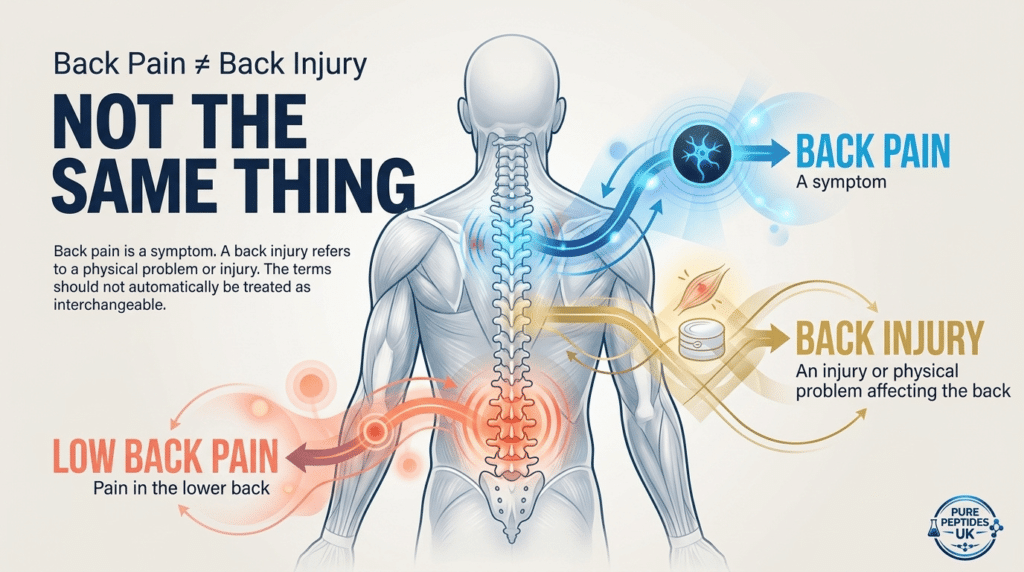
Back pain describes a symptom. It can have many possible causes and can range from mild, short-term discomfort to persistent pain.
Low back pain refers specifically to pain affecting the lower part of the back. WHO defines it as pain between the lower edge of the ribs and the buttocks.
Back injury generally suggests an injury or physical event affecting the back, but the term is used broadly in everyday language and does not correspond to one single medical diagnosis.
Work-related musculoskeletal disorder is a wider occupational-health category that can include back, neck, upper-limb and lower-limb conditions.
Understanding these differences makes statistics much easier to interpret.
Frequently Asked Questions About Back Injury Statistics
How common are back injuries in the UK?
The latest HSE data estimates that around 221,000 workers in Great Britain experienced work-related back disorders in 2024/25. This figure refers to work-related musculoskeletal disorders mainly involving the back and includes new and long-standing cases.
How many people worldwide have low back pain?
WHO estimates that 619 million people worldwide experienced low back pain in 2020. The organisation projects that this could increase to approximately 843 million cases by 2050, largely because of population growth and ageing.
Is back pain the leading cause of disability worldwide?
Yes. WHO identifies low back pain as the single leading cause of disability worldwide. This refers to its contribution to global disability rather than mortality.
What percentage of low back pain is non-specific?
WHO estimates that about 90% of low back pain is non-specific, meaning that a specific disease, structural problem or other identifiable cause cannot confidently explain the symptoms.
What percentage of UK sickness absence is related to musculoskeletal problems?
According to the latest ONS data, musculoskeletal problems accounted for 14.6% of sickness-absence occurrences in the UK in 2025. The category includes back pain, neck and upper-limb problems and other musculoskeletal conditions.
How many UK adults experience chronic pain?
The 2024 Health Survey for England found that 26% of adults reported chronic pain. The survey defined chronic pain as pain experienced most days or every day during the previous three months.
Is back pain the same as a back injury?
No. Back pain is a symptom, while a back injury generally refers to an injury or physical problem affecting the back. A person can experience low back pain without having a clearly identifiable injury.
Will back pain become more common worldwide?
The total number of people experiencing low back pain is expected to increase. WHO projects an increase from 619 million cases in 2020 to 843 million by 2050. Population growth and ageing are expected to be major contributors.
Conclusion: What the Latest Back Injury Statistics Tell Us
The latest evidence shows that back problems remain a significant health and workplace issue in the UK and around the world. In Great Britain, around 221,000 workers experienced work-related back disorders in 2024/25, while approximately 511,000 workers experienced work-related musculoskeletal disorders overall. The latest ONS data also shows that musculoskeletal problems accounted for 14.6% of sickness-absence occurrences in the UK in 2025.
The global picture is even broader. The World Health Organization estimates that 619 million people experienced low back pain in 2020, with the number projected to reach 843 million by 2050. Low back pain is already recognised as the world’s leading cause of disability, highlighting that its impact extends far beyond workplace injuries.
At Pure Peptides, we believe these statistics need to be interpreted carefully. Back pain, back injury, chronic pain and work-related musculoskeletal disorders are not interchangeable terms, and different studies measure different populations and outcomes. Looking at the source, definition and year behind each statistic is therefore essential.
Overall, the data points to a continuing need for better research, workplace risk management and greater understanding of the factors associated with back and musculoskeletal problems. As new UK and international studies become available, Pure Peptides aims to provide research-focused information that helps readers keep up with changing evidence and understand how the burden of back problems develops over time.
References & Data Sources
- Health and Safety Executive (HSE). Work-related musculoskeletal disorders statistics in Great Britain, 2025. Data for 2024/25. HSE — Work-related musculoskeletal disorders statistics
- Health and Safety Executive (HSE). Key figures for Great Britain 2024 to 2025. HSE — Key figures for Great Britain
- Health and Safety Executive (HSE). Working days lost in Great Britain. 2024/25 Labour Force Survey estimates. HSE — Working days lost in Great Britain
- Office for National Statistics (ONS). Sickness absence in the UK labour market: 2025. ONS — Sickness absence in the UK labour market
- World Health Organization (WHO). Low back pain. 19 June 2023. WHO — Low back pain
- World Health Organization (WHO). WHO releases guidelines on chronic low back pain. 7 December 2023. WHO — Guidelines on chronic low back pain
- World Health Organization (WHO). Musculoskeletal health. WHO — Musculoskeletal health
- Health and Safety Executive (HSE). Health and safety statistics. Great Britain, 2024/25. HSE — Health and safety statistics