
Interest in multi-peptide research products has grown as researchers examine compounds associated with different areas of molecular biology. KLOW blend is a name used for a combination of four distinct peptides: GHK-Cu, BPC-157, TB-500 and KPV. Each has a separate molecular identity and a different body of published research. Understanding these components is important when evaluating the blend as a research material, particularly because findings about an individual peptide do not establish the properties of the combined formulation.
This guide examines the peptides commonly associated with KLOW, their molecular characteristics, the research areas in which they appear, and the key distinctions between individual-compound evidence and research on a multi-peptide blend.
What Is the KLOW Peptide Blend?
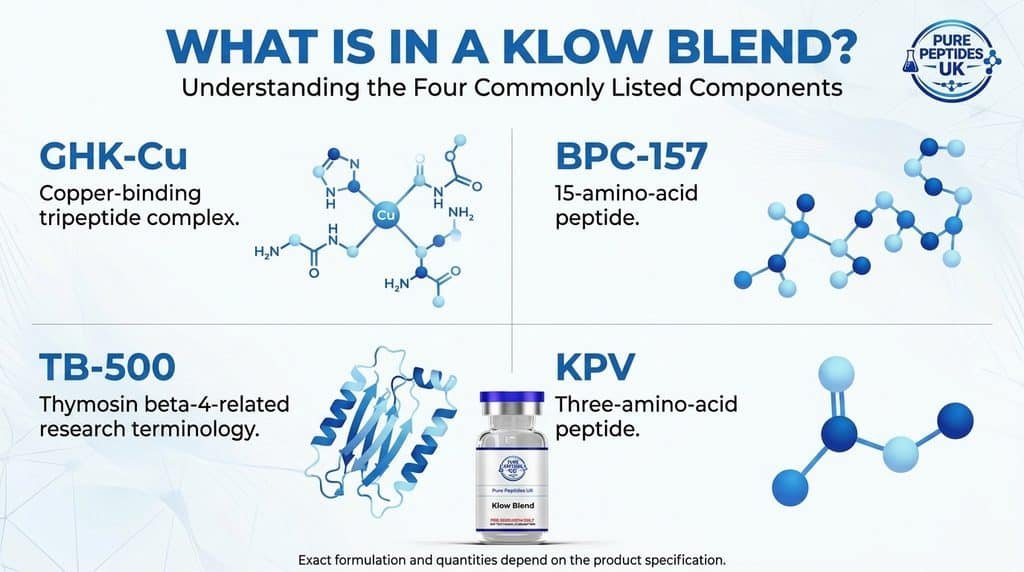
KLOW is a commercial blend designation rather than the scientific name of one peptide molecule. It is commonly used for a formulation containing GHK-Cu, BPC-157, TB-500 and KPV.
A frequently listed formulation contains 80 mg of total peptide material, divided as follows. Exact composition can vary by supplier, so the relevant product specification should always take precedence over a general description of KLOW.
| Peptide component | Commonly listed amount | Molecular identity |
| GHK-Cu | 50 mg | Copper-binding tripeptide complex |
| BPC-157 | 10 mg | Synthetic 15-amino-acid peptide |
| TB-500 | 10 mg | Commercial name associated with a thymosin beta-4-related peptide |
| KPV | 10 mg | Three-amino-acid peptide |
| Total | 80 mg | Four-component blend |
These quantities describe one commonly marketed formulation, not a universal standard. The name KLOW does not establish a fixed composition, a standardised ratio, or evidence that all four components produce a particular combined effect.
The blend is also not a newly discovered single molecule. Each component retains its own chemical identity, and the scientific literature must be interpreted accordingly.
GHK-Cu: The Copper-Binding Peptide
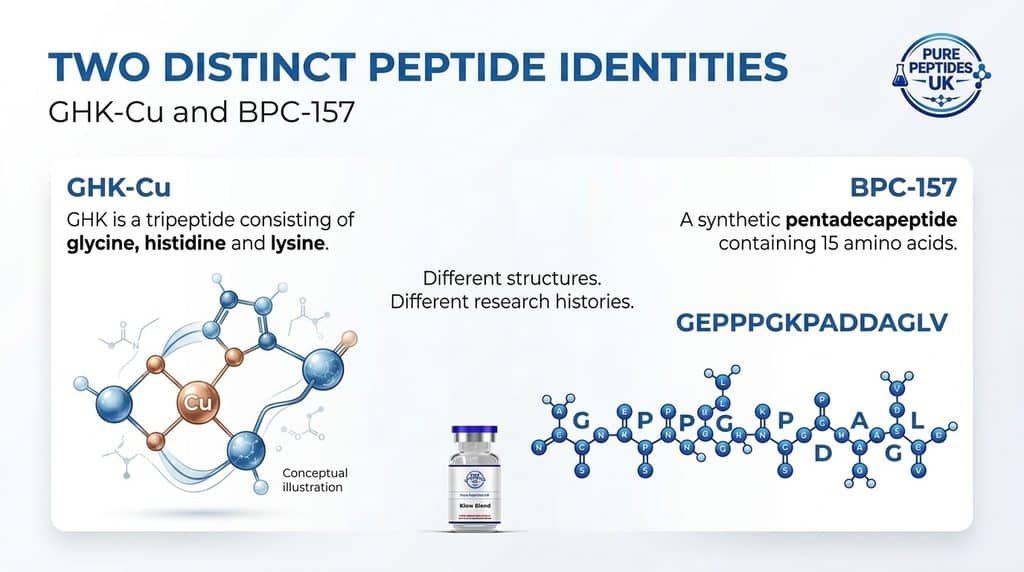
GHK-Cu is one of the most recognisable components in discussions of peptide research blends. The name refers to a complex formed by GHK, a tripeptide consisting of glycine, histidine and lysine, with copper.
GHK has been investigated in connection with copper binding, cellular signalling and extracellular-matrix biology. The extracellular matrix is the network of proteins and other materials surrounding cells. It helps provide structural support and influences how cells interact with their local environment.
Research into GHK and GHK-Cu has explored several biological processes, including gene-expression patterns and the regulation of proteins associated with the extracellular matrix. However, the findings depend on the experimental model, the chemical form studied and the conditions under which the experiments were conducted.
For KLOW research, an important distinction is that GHK and GHK-Cu are related but not identical materials. The copper-associated form should not be described simply as interchangeable with the copper-free tripeptide.
Researchers evaluating a product listing should therefore establish whether it specifies GHK-Cu and whether the stated composition matches the intended research material.
Research perspective: GHK-Cu contributes a copper-binding peptide complex to the blend. Its individual research literature does not establish the effects, stability or performance of the complete KLOW formulation.
BPC-157: A Distinct Fifteen-Amino-Acid Peptide
BPC-157 is a synthetic pentadecapeptide, meaning that its sequence contains 15 amino acids. Its commonly reported sequence is:
GEPPPGKPADDAGLV
BPC-157 has been examined in preclinical research involving several biological systems. Published studies have investigated its interactions with cellular signalling, vascular processes and tissue-related experimental models.
A major consideration is the level of evidence. Much of the published literature concerns laboratory experiments and animal models. Findings in those settings cannot automatically be translated into conclusions about human safety, effectiveness or clinical outcomes.
The distinction matters particularly in a multi-component product. Evidence relating to BPC-157 alone does not establish how it behaves when formulated alongside GHK-Cu, TB-500 and KPV.
The peptide’s sequence also helps distinguish it from the other components. BPC-157 is not a copper-binding tripeptide like GHK-Cu, nor is it the same molecular entity as the thymosin beta-4-related peptide commonly identified as TB-500.
For product-focused research, the central point is straightforward: BPC-157 has its own molecular identity and its own research record. Those characteristics should remain distinct when the peptide is discussed as one ingredient within a blend.
TB-500: Understanding the Thymosin Beta-4 Connection
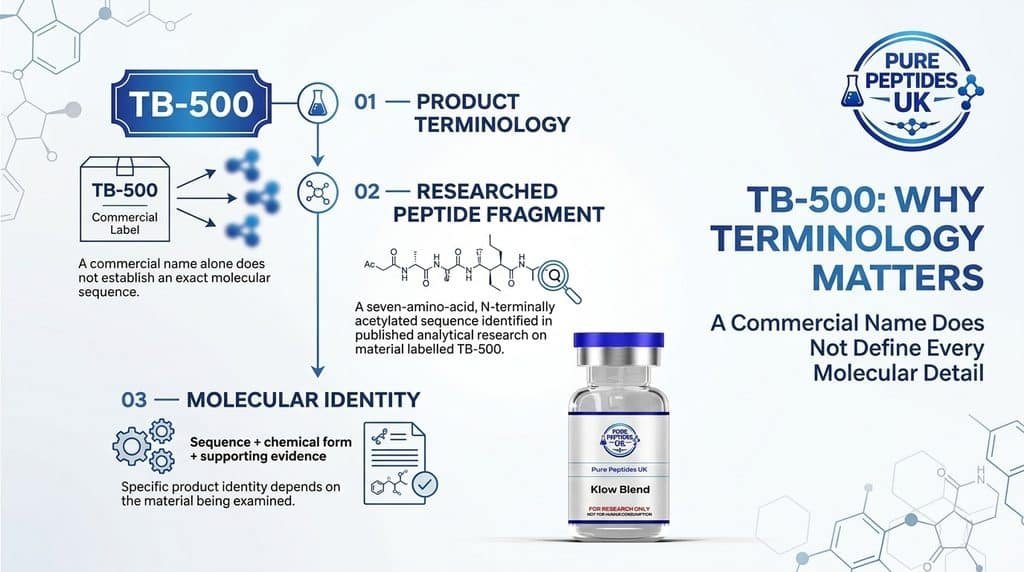
TB-500 requires particular attention to terminology because its name is frequently associated with thymosin beta-4 in product descriptions and online research discussions.
Thymosin beta-4 is a naturally occurring protein involved in cellular processes, including actin regulation. Actin is an important structural protein that helps cells maintain their shape and participate in movement.
However, thymosin beta-4 and a shorter peptide fragment associated with commercial TB-500 terminology should not automatically be treated as the same molecular entity.
A 2012 analytical study published in Drug Testing and Analysis reported the identification of the N-terminally acetylated sequence Ac-LKKTETQ, corresponding to residues 17–23 of thymosin beta-4, in material identified as TB-500. The researchers used chromatographic and high-resolution mass-spectrometric methods to investigate the peptide.
This distinction is relevant when reading KLOW product descriptions. A general reference to TB-500 does not, by itself, establish the precise sequence, chemical form or specification of the material included in a particular formulation.
The article should therefore avoid assuming that every product labelled TB-500 contains full-length thymosin beta-4. The exact identity should be determined from the applicable product specification.
Research perspective: TB-500 terminology has a specific analytical history. Understanding that history helps prevent different peptide forms from being grouped together simply because their names are related.
KPV: A Three-Amino-Acid Peptide
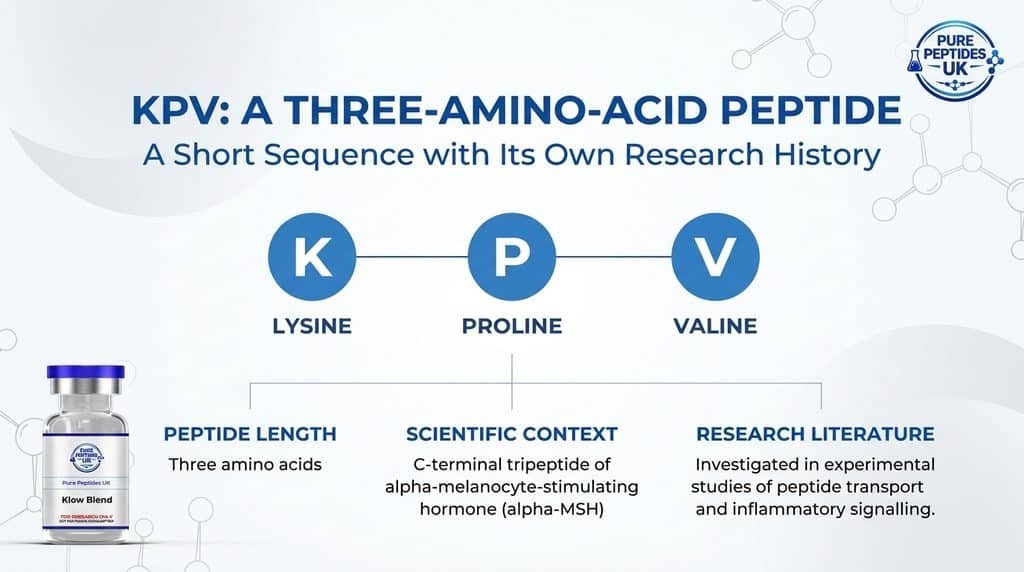
KPV is a short peptide made up of three amino acids:
Lysine–Proline–Valine (KPV)
It is described in scientific literature as the C-terminal tripeptide of alpha-melanocyte-stimulating hormone, commonly abbreviated as alpha-MSH.
Research has investigated KPV in connection with inflammatory signalling and cellular responses. For example, a 2007 study published in Gastroenterology examined KPV uptake through the peptide transporter PepT1 and evaluated its effects in cell experiments and mouse models of intestinal inflammation.
A separate 2008 study investigated KPV in two murine models of inflammatory bowel disease. These findings provide context for why KPV appears in research discussions involving inflammatory pathways.
They do not establish that KPV has the same effects in humans, nor do they demonstrate that KPV produces a particular outcome when combined with the other three KLOW components.
Its short sequence also illustrates an important feature of peptide research: peptides with very different lengths can have distinct molecular properties and research histories, even when they appear in the same formulation.
For KLOW, KPV represents an additional, chemically distinct component. Its individual literature should be evaluated independently of claims about the combined product.
KLOW vs GLOW: Understanding the Naming Difference
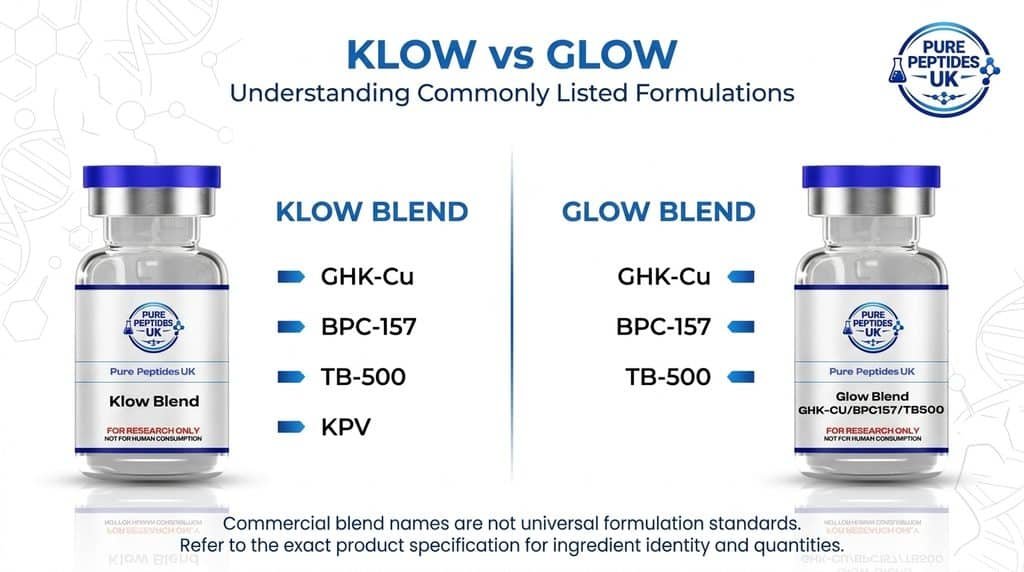
KLOW is often discussed alongside GLOW, another commercial name used for a multi-peptide blend.
| Feature | KLOW blend | GLOW blend |
| Commonly listed components | GHK-Cu, BPC-157, TB-500 and KPV | GHK-Cu, BPC-157 and TB-500 |
| KPV included | Commonly yes | Commonly no |
| One single peptide molecule | No | No |
| Formula standardised across all suppliers | No | No |
| Evidence for the complete blend established by studies of its ingredients alone | No | No |
These names describe commercial formulations, not universally standardised chemical entities. Suppliers may use different ingredient quantities or specifications, so the name alone should not be used to infer the exact composition.
The addition of another peptide also does not establish that a blend is more effective, more stable or more suitable for a particular research question. Those conclusions require evidence specific to the formulation being examined.
What Does the Research Say About KLOW as a Complete Blend?
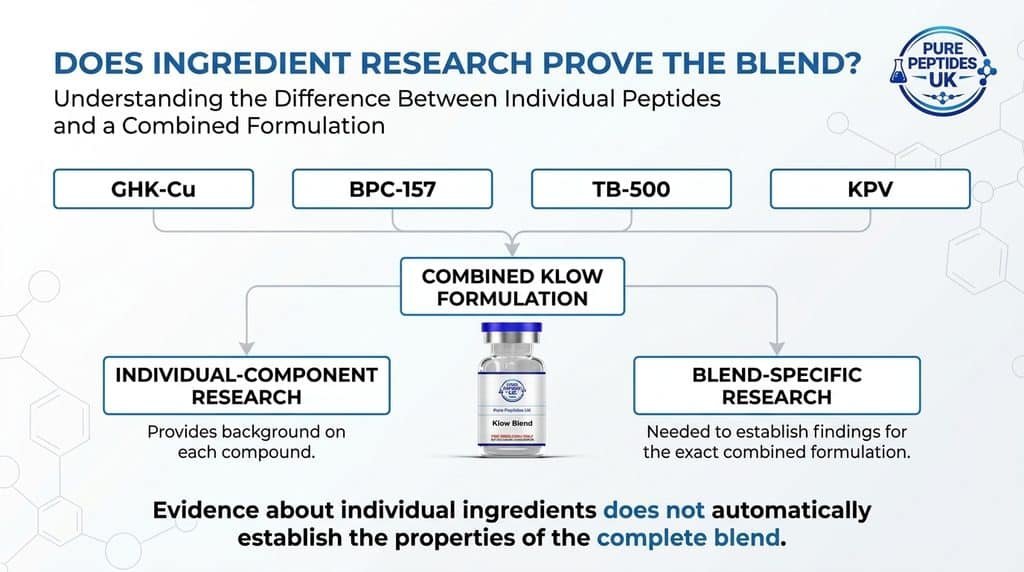
The most important distinction in evaluating KLOW is the difference between research on its ingredients and research on the combined formulation.
Each component has its own scientific literature:
- GHK-Cu: Research involving copper binding, gene expression and extracellular-matrix biology.
- BPC-157: Preclinical studies examining a range of cellular and tissue-related processes.
- TB-500: Analytical literature concerning peptide identity and its relationship to thymosin beta-4.
- KPV: Research examining peptide transport and inflammatory signalling in laboratory and animal models.
These separate research records provide background on the compounds. They do not demonstrate that the four-peptide mixture has the same properties as each ingredient studied independently.
A study of one peptide cannot establish that the complete blend has additive or synergistic effects. Likewise, findings from a two-component combination cannot automatically be applied to a four-component formulation.
To establish the properties of KLOW itself, researchers would need studies that explicitly investigate the exact combination, its composition and the relevant experimental outcomes.
This is an important limitation when evaluating product descriptions. The presence of several individually studied compounds does not establish the scientific validity of every claim made about their combination.
What Should Researchers Know About KLOW Product Specifications?
When evaluating a KLOW-labelled research material, the product name is only the starting point. The formulation details determine which material is actually being described.
Key considerations include:
- Ingredient identity: Confirm that the product specification lists the intended four components.
- Individual quantities: Check the stated amount of each peptide rather than relying only on a total blend weight.
- Chemical form: Distinguish related but non-identical peptide forms, particularly when interpreting TB-500 terminology.
- Formulation details: Determine whether the stated composition corresponds to the specific research material under consideration.
- Research documentation: Keep the product specification and relevant batch documentation associated with the material being evaluated.
These considerations are useful for accurate research documentation and product comparison. They do not substitute for evidence establishing the biological properties of the complete blend.
For Pure Peptides UK, product information should clearly reflect the actual formulation offered. Any component quantities or identity statements published on the product page should match the corresponding product specifications.
Frequently Asked Questions
What peptides are commonly included in KLOW blend?
KLOW is commonly associated with four components: GHK-Cu, BPC-157, TB-500 and KPV. The exact composition and quantities depend on the supplier’s formulation.
Is KLOW a single peptide?
No. KLOW is a commercial name for a multi-component formulation. Its ingredients are separate peptides or peptide complexes with distinct molecular identities.
What is the difference between KLOW and GLOW?
KLOW commonly includes GHK-Cu, BPC-157, TB-500 and KPV. GLOW commonly refers to a three-component blend containing GHK-Cu, BPC-157 and TB-500. These names are not universal formulation standards.
Does research on the individual peptides prove the effects of KLOW?
No. Studies involving individual ingredients do not establish the effects, safety or performance of the complete blend. Those questions require research on the specific combined formulation.
Is TB-500 the same as full-length thymosin beta-4?
The terms should not automatically be treated as interchangeable. Published analytical research has identified the acetylated seven-amino-acid sequence Ac-LKKTETQ in material identified as TB-500. The precise identity of a product should be established from its specifications.
Why do KLOW formulations differ between suppliers?
KLOW is a commercial blend name rather than a universally standardised chemical formula. Suppliers may specify different ingredient amounts or material forms, making the actual product listing important.
Final Research Perspective
KLOW brings together four distinct research components, each with its own molecular identity and scientific background. GHK-Cu is a copper-binding tripeptide complex, BPC-157 is a 15-amino-acid peptide, TB-500 terminology is linked to thymosin beta-4-related peptide research, and KPV is a three-amino-acid peptide derived from alpha-MSH.
Understanding these distinctions makes it easier to interpret product descriptions without confusing the evidence for an individual compound with evidence for the entire formulation.
For research-focused evaluation, the most useful starting point is a clear account of the ingredients, their specified quantities and their respective research histories. Claims about the combined blend should remain limited to what studies of that formulation actually establish.
Research Use Notice: This article is provided for scientific and educational information. It does not provide medical advice or establish the safety or effectiveness of KLOW or any individual component for human use. Research findings should be interpreted within the limitations of the relevant experimental models and published evidence.
Sources:
- KPV uptake through PepT1 and intestinal inflammation research, Gastroenterology (2007)
- KPV in murine models of inflammatory bowel disease, Inflammatory Bowel Diseases (2008)
- Analytical identification of Ac-LKKTETQ in TB-500, Drug Testing and Analysis (2012)
- BPC-157 literature review and research context (2025)