
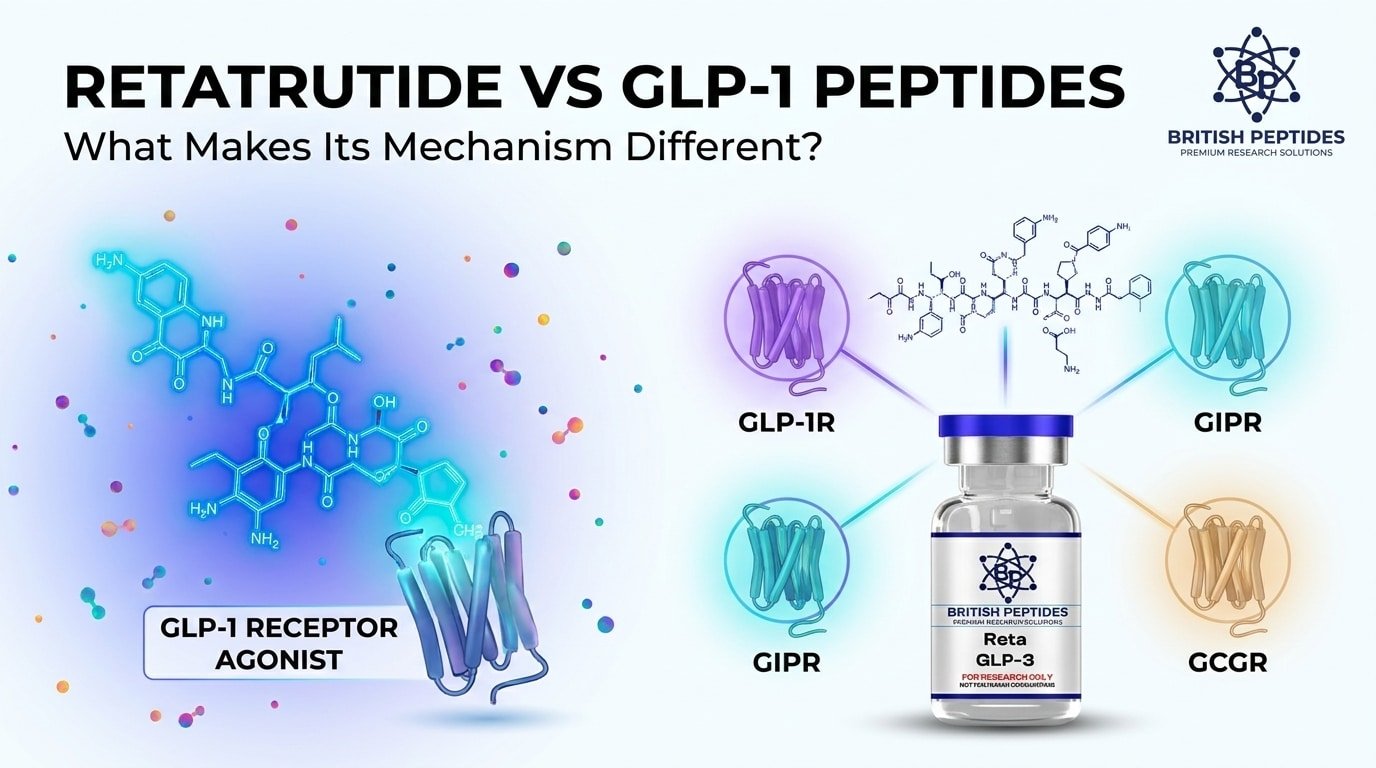
Retatrutide is often grouped with GLP-1 peptides because it shares an important receptor target with established incretin-based compounds. However, that classification does not tell the whole story. Its molecular design belongs to a broader category of multi-receptor agonists, making it scientifically different from conventional single-target GLP-1 receptor agonists.
Understanding this distinction requires looking beyond the GLP-1 label. The number of receptor targets, peptide architecture and intended pharmacological activity all influence how researchers classify these compounds.
Why the Term GLP-1 Peptides Can Be Misleading
The phrase “GLP-1 peptides” is frequently used as a broad description for compounds associated with GLP-1 biology. However, it can refer to several different things.
GLP-1 itself is a naturally occurring incretin hormone. GLP-1R is the receptor that recognises this hormone, while GLP-1 receptor agonists are molecules designed to activate that receptor.
These terms are related, but they are not interchangeable.
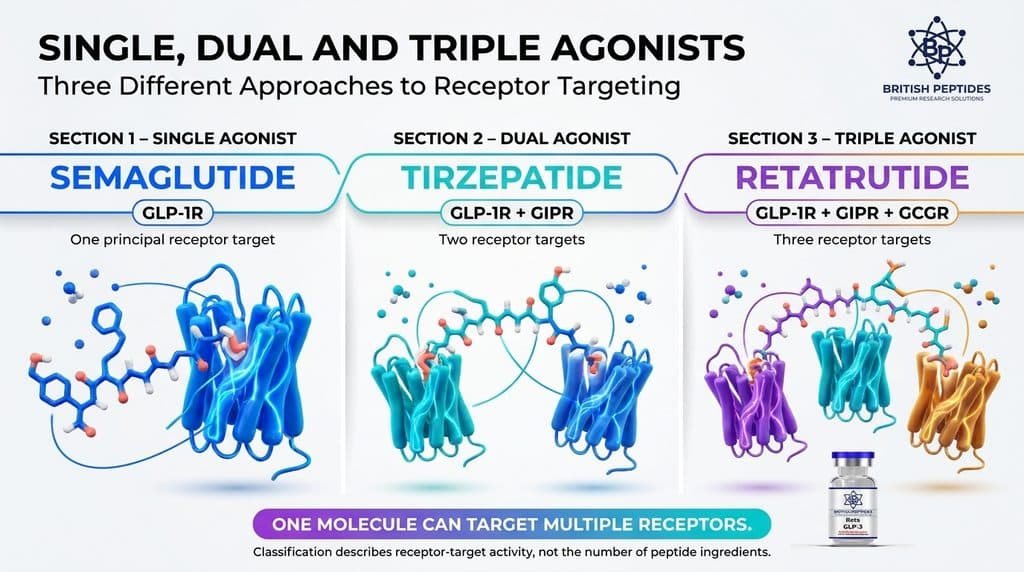
For example, semaglutide is classified as a GLP-1 receptor agonist. Tirzepatide belongs to a dual-agonist category because its molecular design includes activity at two receptor targets. Retatrutide is classified as a triple agonist.
All three compounds are connected to incretin research, but they do not belong to exactly the same pharmacological category.
This distinction is important when interpreting scientific publications, product descriptions and peptide classifications.
How Researchers Classify Single, Dual and Triple Agonists
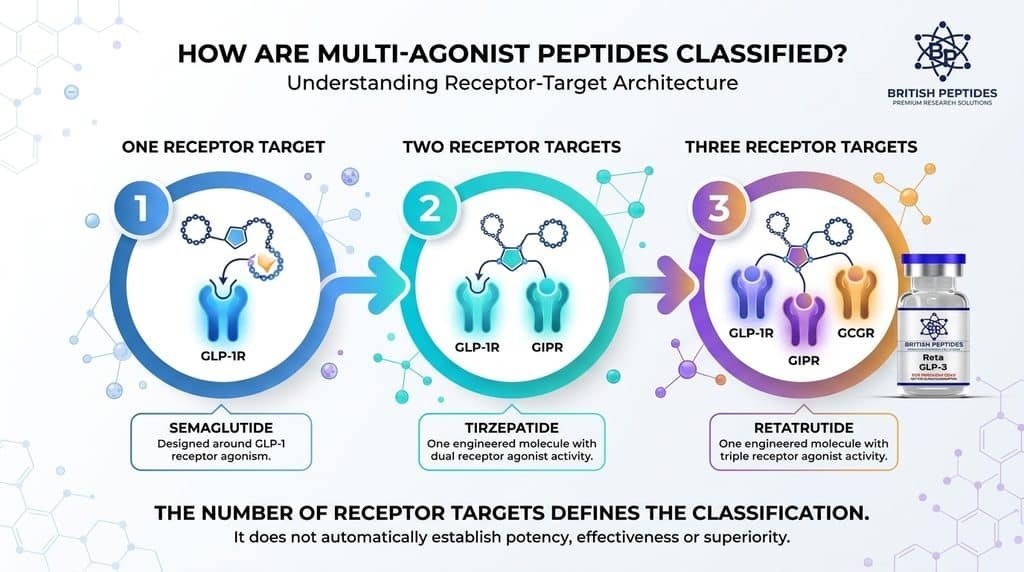
One useful way to understand the expanding incretin research landscape is to classify molecules according to the number of receptor targets they are designed to activate.
This creates three broad categories.
1. Single-Receptor Agonists
Single-receptor agonists are designed to activate one principal receptor target.
Semaglutide is a well-known example. Its pharmacological classification is based on GLP-1 receptor agonism.
Other compounds in this category include liraglutide and dulaglutide.
Although these molecules share a broad pharmacological classification, their amino-acid sequences, molecular modifications, formulation characteristics and pharmacokinetic profiles are not identical.
The single-agonist category therefore describes their principal receptor-target architecture rather than suggesting that every compound has the same molecular structure.
2. Dual-Receptor Agonists
Dual agonists are engineered to interact with two receptor targets through one molecular design.
Tirzepatide is a prominent example of this category. It combines glucose-dependent insulinotropic polypeptide receptor (GIPR) and GLP-1 receptor (GLP-1R) agonist activity.
This represents a different molecular design from compounds developed around GLP-1 receptor activity alone.
The important distinction is that dual agonism introduces another receptor target into the same engineered molecule. It does not simply mean that two separate peptide products are combined.
3. Triple-Receptor Agonists
Triple agonists extend this multi-target design further.
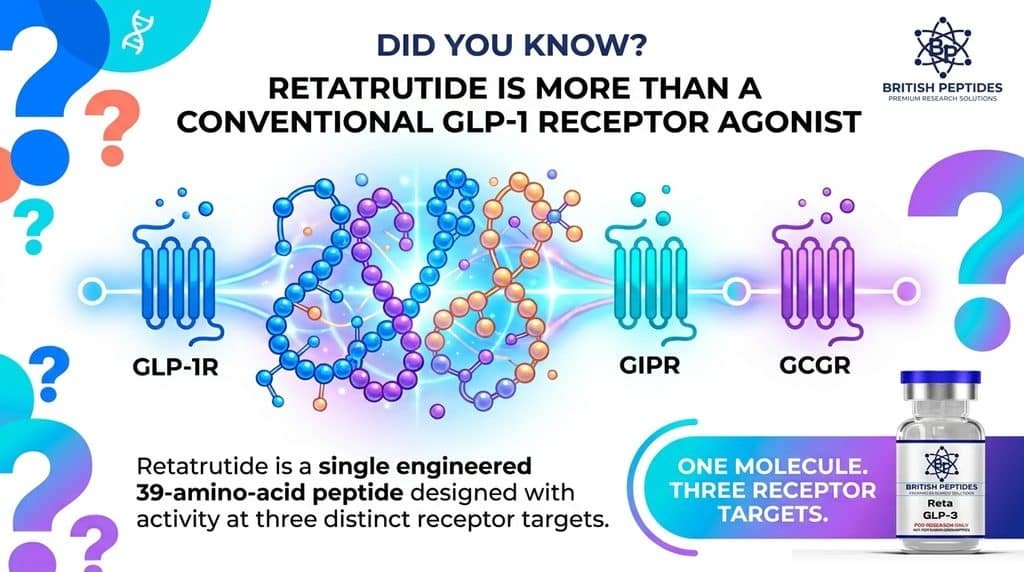
Retatrutide, also known by its development code LY3437943, is a single engineered peptide with activity at three receptor targets:
- GLP-1 receptor (GLP-1R)
- GIP receptor (GIPR)
- Glucagon receptor (GCGR)
Its classification reflects the combined receptor-target architecture of the molecule.
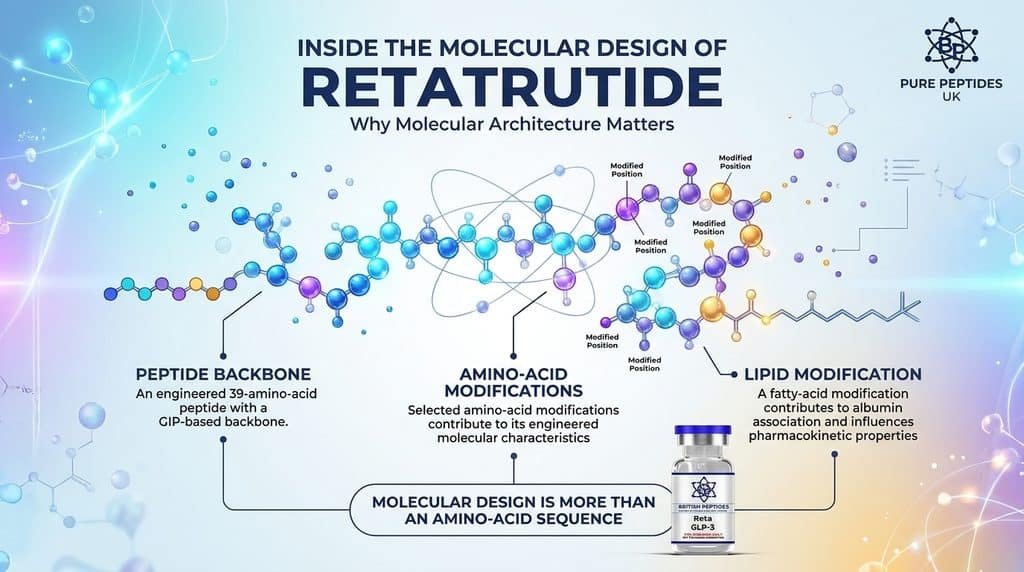
The original discovery publication described retatrutide as a 39-amino-acid peptide engineered from a GIP-based backbone. Its design incorporates molecular modifications that support its multi-target pharmacological profile.
This makes retatrutide different from a conventional GLP-1 receptor agonist, even though GLP-1R remains one of its targets.
Retatrutide vs Other GLP-1 Peptides: The Main Scientific Differences
The most useful way to compare these compounds is to examine their molecular and pharmacological classifications rather than treating them as interchangeable members of one category.
| Compound | Broad classification | Principal receptor targets | Molecular design category |
| Semaglutide | Single agonist | GLP-1R | GLP-1 analogue |
| Liraglutide | Single agonist | GLP-1R | GLP-1 analogue |
| Dulaglutide | Single agonist | GLP-1R | GLP-1 receptor fusion protein |
| Tirzepatide | Dual agonist | GIPR and GLP-1R | GIP-based engineered peptide |
| Retatrutide | Triple agonist | GIPR, GLP-1R and GCGR | GIP-based engineered peptide |
The table highlights three important distinctions.
First, receptor count differs. Conventional GLP-1 receptor agonists are classified around one principal target, while tirzepatide and retatrutide have additional receptor activity.
Second, molecular architecture differs. Compounds can belong to the same broad research category without sharing identical amino-acid sequences or structural modifications.
Third, classification does not establish comparative performance. A molecule with more receptor targets is not automatically more potent or scientifically superior.
These distinctions help prevent oversimplified comparisons between compounds that have different molecular designs.
Why Retatrutide Is Not Simply Another GLP-1 Analogue
Calling retatrutide a GLP-1 analogue without further explanation can create an incomplete picture of its molecular identity.
The compound was developed using a GIP-based peptide backbone, rather than simply reproducing the structure of native GLP-1.
Its design includes selected non-proteinogenic amino-acid modifications and a lipid-associated component. These features form part of the wider engineering strategy used to develop a single molecule with multiple receptor targets.
This is an important distinction in peptide science.
A molecule’s original sequence or structural inspiration does not necessarily define all of its pharmacological targets. Through peptide engineering, researchers can modify a molecular scaffold to influence its interactions with more than one receptor.
Consequently, retatrutide is better described as a unimolecular triple agonist than as a conventional GLP-1 receptor agonist. If you’re researching the science behind buy retatrutide peptide in UK searches, it is important to understand that retatrutide remains an investigational compound and is not an approved medicine for general use.
Explore its molecular design and research background before concluding product listings or marketing claims.The distinction is supported by the original discovery research published in Cell Metabolism in 2022 and subsequent structural research published in Cell Discovery in 2024.
What Does Unimolecular Multi-Agonism Mean?
The term unimolecular refers to a single molecule.
In the context of multi-agonist peptide research, it describes an engineered molecular structure that has activity at more than one receptor target.
This is different from a combination formulation containing two or more separate active compounds.
For example:
- A single GLP-1 receptor agonist has one principal receptor target.
- A dual agonist is one engineered molecule with two receptor targets.
- A triple agonist is one engineered molecule with three receptor targets.
This distinction is useful because the number of receptor targets does not necessarily correspond to the number of peptide ingredients.
The molecular structure itself must be examined to establish whether a compound is a single multi-agonist or a combination of separate active ingredients.
Researchers use structural analysis and functional receptor assays to investigate these characteristics.
Why More Receptor Targets Do Not Automatically Mean Greater Potency
A common misunderstanding in multi-agonist research is that increasing the number of receptor targets automatically increases a compound’s potency.
That is not how pharmacological classification works.
Receptor count describes the number of targets associated with a molecule. Potency describes the concentration required to produce a defined response in a particular experimental system.
These are separate concepts.
A multi-agonist may show different levels of activity at each receptor. Results can also vary according to the assay system, receptor expression and experimental conditions.
The same principle applies when interpreting comparisons between single-, dual- and triple-agonist molecules.
For example, retatrutide’s classification as a triple agonist does not mean that it has three times the activity of a single agonist. Nor does the classification independently establish superior performance.
A meaningful scientific comparison requires defined experimental measurements and an understanding of the methods used to obtain them.
How Molecular Design Shapes Multi-Target Peptide Research
Multi-target peptide engineering involves more than adding another receptor label to a compound.
Researchers must consider how the molecular structure interacts with different receptor environments while maintaining suitable stability and pharmacological characteristics.
Several aspects are particularly relevant.
Peptide Sequence
The amino-acid sequence forms the molecular foundation of a peptide.
Changes to individual residues can influence molecular recognition, structural flexibility and receptor activity.
In multi-target peptide development, sequence optimisation must account for the requirements of several receptor targets rather than only one.
Structural Modifications
Engineered peptides may contain modified amino-acid residues that are not part of the standard proteinogenic amino-acid set.
These modifications can influence stability and molecular behaviour.
Their effects must be evaluated experimentally because a structural change that supports one characteristic may influence another.
Lipid-Associated Modifications
Some engineered peptide molecules contain lipid-associated components.
These modifications can influence albumin association and pharmacokinetic behaviour.
However, lipidation is not exclusive to triple agonists. Different peptide categories can use lipid modifications for different molecular-development purposes.
Molecular Recognition
The ability of a peptide to interact with multiple receptor targets depends on the relationship between its molecular structure and the binding characteristics of each receptor.
Structural studies help researchers investigate these interactions.
The 2024 Cell Discovery publication examining retatrutide provides structural evidence of its interactions with GLP-1R, GIPR and GCGR.
Together, these areas demonstrate why peptide classification should consider molecular architecture as well as receptor-target count.
How Should Researchers Interpret Evidence Across These Categories?
Comparing research publications involving different agonist categories requires attention to study design and evidence quality.
Not every publication measures the same scientific outcome. Laboratory experiments, animal models and human clinical studies answer different research questions.
The following considerations are particularly important:
| Research consideration | Why it matters |
| Molecular identity | Confirms which compound was actually investigated |
| Receptor classification | Establishes the compound’s intended target architecture |
| Experimental model | Identifies whether evidence comes from cells, animals or human research |
| Assay methodology | Explains how receptor activity was measured |
| Study design | Helps determine what conclusions the research can support |
| Evidence maturity | Distinguishes early molecular findings from larger clinical research programmes |
A laboratory study showing activity at multiple receptor targets does not independently establish a clinical outcome.
Likewise, findings from one compound should not automatically be applied to another molecule simply because both are associated with incretin research.
This is especially important when reviewing research involving single-, dual- and triple-agonist peptides.
What Does the Expanding Multi-Agonist Research Landscape Tell Us?
Research into incretin-related molecules has expanded beyond conventional single-receptor designs.
Scientists are investigating engineered compounds that target different combinations of hormonal receptors, including dual- and triple-agonist structures.
Retatrutide represents one example of this broader research direction.
However, the wider research landscape is not limited to a simple progression from one receptor to two and then three.
Researchers are also investigating other molecular strategies, including combinations involving amylin-related pathways and additional nutrient-responsive hormonal targets.
The scientific importance of this work lies in the ability to investigate different molecular architectures and understand how their individual components contribute to observed experimental responses.
For peptide research, this creates opportunities to examine sequence design, receptor selectivity, structural optimisation and the relationship between molecular characteristics and biological activity.
It also reinforces the need to assess every compound individually rather than assuming that all incretin-related peptides share the same properties.

Frequently Asked Questions
Is retatrutide a GLP-1 peptide?
Retatrutide is associated with GLP-1 research because it has GLP-1 receptor agonist activity. However, it is more accurately classified as a triple agonist because its molecular design also includes GIP and glucagon receptor activity.
What is the difference between GLP-1 agonists and multi-agonists?
Conventional GLP-1 receptor agonists are designed around GLP-1R activity. Multi-agonists are engineered to activate additional receptor targets through one molecular design.
Is retatrutide a single or triple agonist?
Retatrutide is a single engineered peptide with triple-agonist activity. It targets GLP-1R, GIPR and GCGR.
How is tirzepatide different from retatrutide?
Tirzepatide is classified as a dual GIP and GLP-1 receptor agonist, while retatrutide is classified as a triple agonist with an additional glucagon receptor target.
Does a triple agonist contain three different peptides?
No. Triple agonism describes the activity of one molecule across three receptor targets. It does not mean that three separate peptide ingredients are necessarily combined.
Does having more receptor targets mean greater potency?
No. Receptor-target count and potency are different pharmacological concepts. Potency must be established through defined experimental measurements.
Why is retatrutide described as a GIP-based peptide?
Its engineered molecular backbone is based on a GIP-related peptide structure. Additional modifications contribute to its multi-target pharmacological design.
Are all GLP-1-related peptides structurally identical?
No. Compounds associated with GLP-1 research can have different amino-acid sequences, molecular modifications, structures, and receptor-target profiles.
Final Perspective
Retatrutide occupies a distinct position within the expanding field of incretin-related peptide research. Although it shares GLP-1 receptor activity with conventional GLP-1 receptor agonists, its classification as a triple agonist reflects a broader molecular design involving three receptor targets.
The most important distinction is therefore not simply whether a compound belongs to GLP-1 research, but how its molecular structure and receptor-target architecture define its pharmacological classification.
Understanding the differences between single-, dual-, and triple-agonist peptides provides a clearer framework for interpreting scientific publications and evaluating the expanding range of engineered peptide molecules.
Pure Peptides UK supports research-focused exploration of peptide science through educational information about molecular identity, peptide classification, and emerging scientific developments.
Research-use notice: This article is intended solely for scientific and educational information. It does not provide medical advice, treatment recommendations, dosing instructions or guidance for human consumption or administration. Retatrutide remains an investigational compound and is not an MHRA-authorised medicine in the UK.
Scientific References
- Alfaris N. et al. (2024). GLP-1 single, dual, and triple receptor agonists for treating type 2 diabetes and obesity: a narrative review. eClinicalMedicine.
https://doi.org/10.1016/j.eclinm.2024.102782 - Drucker D.J. (2026). The expanding landscape of GLP-1 medicines. Nature Medicine.
https://doi.org/10.1038/s41591-025-04124-5 - Goldney J. et al. (2025). Triple Agonism-Based Therapies for Obesity. Current Cardiovascular Risk Reports.
https://doi.org/10.1007/s12170-025-00770-z - Coskun T. et al. (2022). LY3437943, a novel triple glucagon, GIP, and GLP-1 receptor agonist for glycemic control and weight loss: From discovery to clinical proof of concept. Cell Metabolism.
https://doi.org/10.1016/j.cmet.2022.07.013 - Li W. et al. (2024). Structural insights into the triple agonism at GLP-1R, GIPR and GCGR manifested by retatrutide. Cell Discovery.
https://doi.org/10.1038/s41421-024-00700-0 - Cho Y.K. and Jung C.H. (2026). Engineered nutrient-stimulated hormonal multi-agonists for precision targeting of obesity and metabolic disorders. Clinical and Molecular Hepatology.
https://doi.org/10.3350/cmh.2025.0744