Research into multi-receptor peptide agonists has expanded the study of metabolic signalling, with retatrutide and tirzepatide representing two distinct approaches. Retatrutide is designed to activate three hormone receptors, while tirzepatide targets two. These differences make the compounds important subjects for comparative research, but receptor count alone cannot establish which molecule performs better.
For researchers examining Retatrutide GLP-3 and dual-agonist peptides, understanding the underlying pharmacology, available clinical evidence, and limitations of cross-trial comparisons provides a more reliable basis for evaluating published findings.
Retatrutide vs Tirzepatide: Key Differences at a Glance
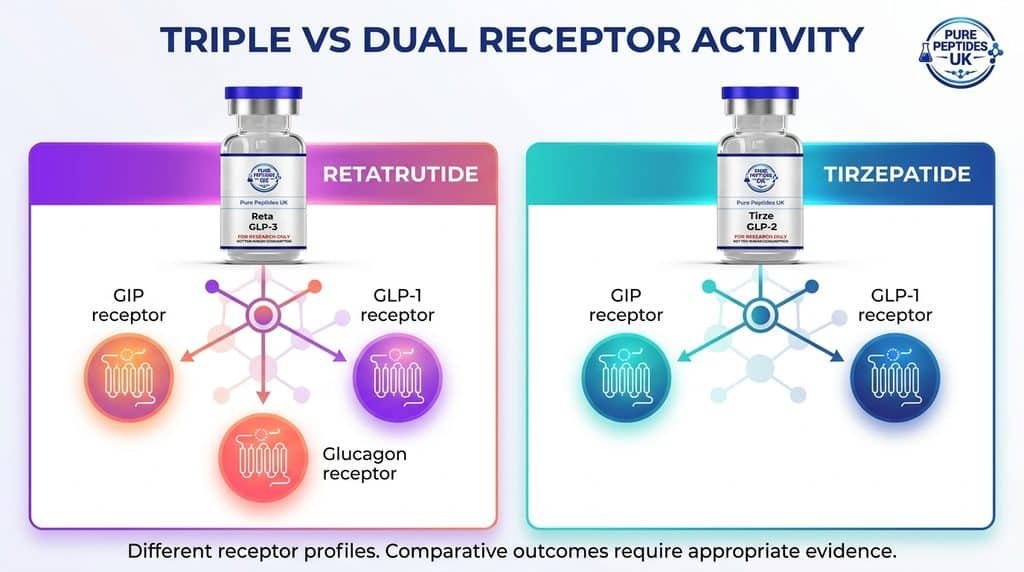
Retatrutide and tirzepatide share activity at the glucose-dependent insulinotropic polypeptide (GIP) and glucagon-like peptide-1 (GLP-1) receptors. Their primary mechanistic distinction is retatrutide’s additional activity at the glucagon receptor.
| Research characteristic | Retatrutide | Tirzepatide |
| Common research designation | Triple-receptor agonist | Dual-receptor agonist |
| GIP receptor activity | Yes | Yes |
| GLP-1 receptor activity | Yes | Yes |
| Glucagon receptor activity | Yes | No |
| Development status | Investigational | Approved medicines exist in certain jurisdictions and indications |
| Key research distinction | Combined GIP, GLP-1 and glucagon receptor activation | Combined GIP and GLP-1 receptor activation |
| Direct comparative evidence | Head-to-head research is underway | Included as the comparator in TRIUMPH-5 |
The receptor profiles are established pharmacological distinctions. However, development status and approved indications must be checked against the relevant regulator and jurisdiction. Tirzepatide’s regulatory status does not imply that every product sold under a research label is approved or suitable for human use.
What Makes Retatrutide a Triple-Receptor Agonist?
Retatrutide, also identified by the development code LY3437943, is an investigational peptide developed to activate three receptors involved in metabolic signalling.
These targets are the GIP receptor, GLP-1 receptor and glucagon receptor. Each is associated with a different set of biological pathways, although their effects can overlap and depend on the experimental setting.
GIP receptor activity
GIP is an incretin hormone involved in nutrient-responsive metabolic signalling. Its receptor participates in glucose-dependent insulin secretion and other physiological processes.
In multi-receptor research, GIP receptor activation is studied alongside GLP-1 receptor activity to understand how combined signalling influences metabolic regulation. The effects of an engineered agonist should not be assumed to match those of the naturally occurring hormone in every tissue or experimental model.
GLP-1 receptor activity
GLP-1 is another incretin hormone. Its receptor is involved in glucose regulation, gastrointestinal processes and appetite-related signalling.
GLP-1 receptor agonism is an established area of pharmaceutical research. Retatrutide and tirzepatide both incorporate this target, but shared receptor activity does not mean the two molecules have identical pharmacological properties.
Glucagon receptor activity
The additional glucagon receptor target distinguishes retatrutide from tirzepatide.
Glucagon signalling participates in energy metabolism, including pathways involved in glucose regulation and energy expenditure. Researchers therefore investigate how glucagon receptor activity interacts with GIP and GLP-1 receptor activation.
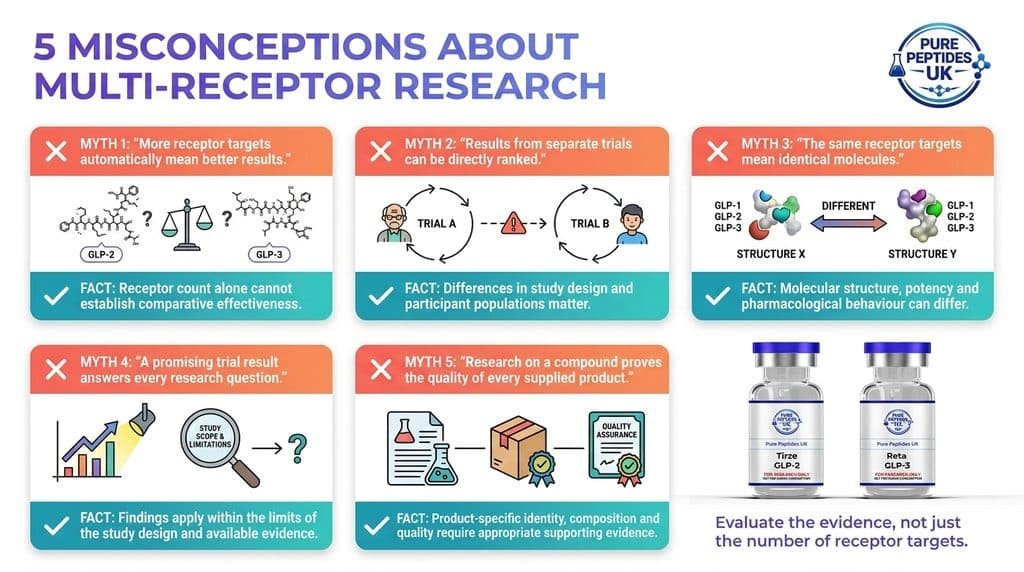
The central research question is not simply whether three targets are better than two. It is how the combined activity, receptor potency, signalling characteristics and pharmacokinetics influence the overall biological response.
The initial Phase 2 retatrutide trial published in The New England Journal of Medicine in 2023 established an important clinical evidence base for further investigation. Subsequent Phase 3 studies have expanded that programme. These findings should be interpreted according to their individual designs and populations rather than treated as proof that receptor count determines clinical outcomes.
Looking to buy Retatrutide for laboratory research? Explore the Retatrutide product range at Pure Peptides UK to review available product specifications and research-related information. All products are intended strictly for research purposes, not human consumption or administration.
How Tirzepatide Differs as a Dual-Receptor Agonist
Tirzepatide, also known as LY3298176, is an engineered peptide agonist of GIP and GLP-1 receptors. Its dual-receptor activity has been investigated in extensive clinical development programmes, including the SURPASS studies in type 2 diabetes and the SURMOUNT programme in obesity.
Combined GIP and GLP-1 signalling
Tirzepatide was designed to activate both GIP and GLP-1 receptors. The interaction between these pathways is a central subject of its pharmacological research.
Its established clinical evidence provides a useful reference point for studying dual-agonist development. However, results from tirzepatide trials cannot be directly transferred to retatrutide because the molecules differ in their receptor profiles and pharmacological characteristics.
Why a dual-target approach remains scientifically relevant
A dual-receptor agonist provides a useful model for investigating how two signalling pathways interact within one molecule. Researchers can evaluate receptor activation, pharmacokinetic behaviour, clinical endpoints and safety outcomes across controlled studies.
Retatrutide introduces an additional target into this research framework. The comparison is therefore relevant to understanding multi-receptor drug design, not just counting how many receptors each compound activates.
Retatrutide vs Tirzepatide: What Does Clinical Research Show?
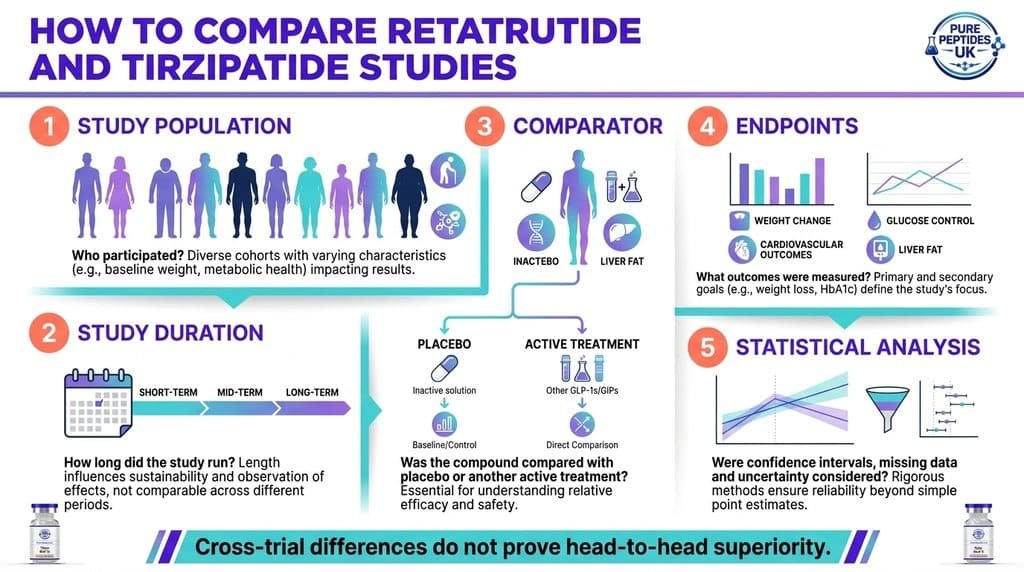
The evidence for the two molecules comes from different clinical development programmes. Comparing their trial results requires attention to the study population, duration, comparator, endpoints and statistical analysis.
Retatrutide clinical research
Retatrutide’s Phase 2 obesity trial, published in 2023, evaluated several doses against placebo over 48 weeks. The study reported substantial changes in body weight, but its findings came from a specific trial population and protocol.
By 2026, the programme had progressed into Phase 3, including the TRIUMPH studies. These trials examine retatrutide across defined populations and clinical outcomes. The published record and subsequent trial reports provide evidence for continued investigation, but results from separate trials should not be interpreted as if participants had been randomly assigned directly between retatrutide and tirzepatide.
Tirzepatide clinical research
Tirzepatide has an established Phase 3 evidence base. For example, the SURMOUNT-1 trial, published in 2022, evaluated tirzepatide against placebo in adults with obesity or overweight and at least one weight-related complication, excluding diabetes.
The trial assessed outcomes over 72 weeks. Its results support conclusions about tirzepatide within that study’s design, dose groups and participant population.
The SURPASS programme separately investigated tirzepatide in type 2 diabetes. Those trials used their own eligibility criteria and endpoints, so their results should not be combined casually with obesity studies or retatrutide trials.
You can buy Tirzepatide at Pure Peptides UK for research purposes and explore the product to review available product specifications and research-related information. All products are intended strictly for research purposes, not human consumption or administration.
Why separate trial results do not establish a winner
A common research error is to compare the largest reported result from one compound with a result from a different study and treat the numerical difference as proof of superiority.
This approach can overlook important differences, including:
- Baseline participant characteristics and eligibility criteria.
- The proportion of participants with type 2 diabetes.
- Trial duration and follow-up periods.
- Dose-escalation protocols and treatment exposure.
- Statistical estimands and how missing data are handled.
- Primary endpoints, secondary endpoints and confidence intervals.
- Discontinuation rates and adverse-event reporting.
A scientifically meaningful comparison requires these factors to be evaluated together. Even when two studies report the same endpoint, their results may not be directly comparable.
What Is the TRIUMPH-5 Head-to-Head Trial?
TRIUMPH-5 is particularly relevant because it is designed to compare retatrutide directly with tirzepatide in adults with obesity.
The study is registered as NCT06662383 and is being conducted within Eli Lilly’s clinical development programme. The trial listing describes a Phase 3 study with an enrolment goal of approximately 800 participants and a planned study period extending to December 2026.
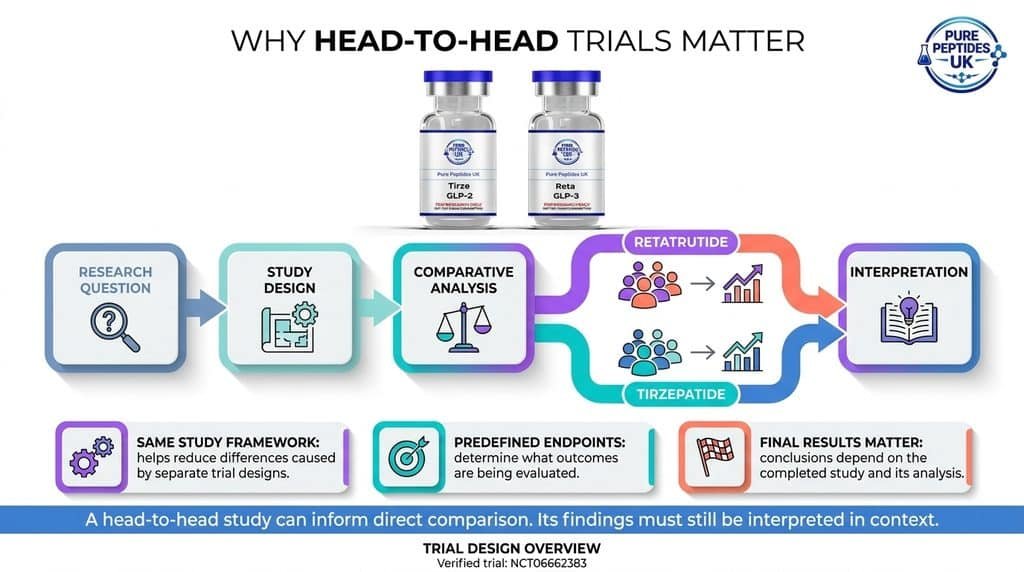
Unlike a comparison of separate placebo-controlled trials, a head-to-head design can evaluate the compounds within the same study framework. This can reduce some of the uncertainty created by differences between independent trials, although the interpretation still depends on the final protocol, endpoints, statistical analysis and results.
At the time of writing, the trial should be treated as an ongoing comparative evidence programme unless an authoritative results publication or registry update confirms otherwise.
Researchers should consult the official trial record for current recruitment status, outcome measures and posted results. The existence of a head-to-head trial does not itself establish that either compound is superior.
Receptor Count Is Not the Same as Pharmacological Superiority
The distinction between triple- and dual-receptor agonism is useful, but it should not be simplified into a ranking.
An additional receptor target may introduce new biological effects, interactions and potential limitations. The overall response depends on several factors, including the molecule’s structure, receptor potency, signalling bias, exposure over time and the tissues in which the receptors are expressed.
Receptor activation is also not necessarily proportional across targets. A molecule may interact differently with each receptor, and those differences can affect the response observed in laboratory experiments or clinical studies.
For this reason, researchers distinguish between receptor binding, receptor activation, downstream signalling and whole-organism outcomes. Evidence at one level does not automatically establish an effect at another.
This distinction is particularly important when evaluating claims that a triple agonist must be more effective than a dual agonist. Such a claim requires direct evidence using appropriate endpoints, not simply a description of the molecule’s target profile.
How Researchers Should Evaluate Comparative Peptide Studies
A structured approach helps keep comparisons evidence-based.
1. Confirm the study design
Determine whether the paper describes a laboratory experiment, an animal study, an early-stage clinical trial or a Phase 3 randomised trial. These designs answer different questions and provide different levels of evidence.
2. Identify the comparator
A placebo-controlled study evaluates a different question from a direct comparison between two active compounds. The comparator determines which conclusions the study can support.
3. Review the population and endpoints
Check who was enrolled, how long the study ran, and which outcomes were designated as primary. Secondary or exploratory findings may be useful, but they should not be presented as equivalent to prespecified primary outcomes.
4. Examine the statistical analysis
Review confidence intervals, missing-data methods, analysis populations and the distinction between statistical significance and practical importance. Headline percentages alone do not provide a complete assessment.
5. Separate published findings from announcements
Company announcements can provide timely information about trial milestones. However, researchers should distinguish preliminary or topline reports from full peer-reviewed publications and consult the final data when available.
These principles apply to retatrutide, tirzepatide and other investigational multi-receptor compounds.
Retatrutide GLP-3 Research and Product Information
The term “GLP-3” is sometimes used informally in discussions of retatrutide. It is not the formal name of a third glucagon-like peptide hormone receptor in this context. Retatrutide is more accurately described as a GIP, GLP-1 and glucagon receptor agonist.
Researchers reviewing Retatrutide GLP-3 product information should distinguish a product’s stated identity and specifications from the clinical evidence for the investigational molecule studied in published trials.
A research product description does not establish that the material is equivalent to the clinical-trial formulation, nor does it establish clinical safety or efficacy. Claims about a supplied product should be supported by appropriate product-specific documentation.
Frequently Asked Questions
What is the main difference between retatrutide and tirzepatide?
Retatrutide activates GIP, GLP-1 and glucagon receptors, while tirzepatide activates GIP and GLP-1 receptors. This is the principal mechanistic distinction between the two compounds.
Is retatrutide more effective than tirzepatide?
A definitive conclusion cannot be drawn from receptor count or comparisons between separate clinical trials. The TRIUMPH-5 head-to-head study is designed to evaluate the two compounds directly, and its results must be interpreted using the published protocol and data.
Why is retatrutide described as a triple agonist?
The term refers to its activity at three targets: the GIP receptor, the GLP-1 receptor and the glucagon receptor. It describes the compound’s pharmacological design rather than proving superior clinical performance.
What does dual-receptor agonism mean for tirzepatide?
It means that tirzepatide activates two receptor targets, GIP and GLP-1. Its clinical research programme evaluates the resulting effects in specific populations and under defined study conditions.
Is GLP-3 the official scientific name for retatrutide?
No. GLP-3 is an informal label sometimes used in marketing or online discussions. Retatrutide is more accurately described as a triple GIP, GLP-1 and glucagon receptor agonist.
Can findings from tirzepatide studies be applied to retatrutide?
Not automatically. The compounds have different receptor profiles and may differ in pharmacological behaviour. Each finding must be interpreted within the specific compound, study design and population examined.
Where can researchers find reliable comparative evidence?
Useful starting points include peer-reviewed journal articles, ClinicalTrials.gov records, official regulatory information and the relevant clinical development programme. For TRIUMPH-5, consult the official trial record for current status and results.
Conclusion
Retatrutide and tirzepatide illustrate two approaches to multi-receptor peptide development. Retatrutide combines GIP, GLP-1 and glucagon receptor activity, while tirzepatide combines GIP and GLP-1 receptor activity.
At Pure Peptides UK, we focus on research-related information that helps readers understand peptide pharmacology, clinical development and emerging scientific evidence. However, differences in receptor count alone cannot establish comparative effectiveness. Researchers should assess trial design, participant characteristics, endpoints, statistical methods and safety findings before drawing conclusions.
As direct comparative evidence develops, Pure Peptides UK encourages an evidence-focused approach that distinguishes established findings from preliminary reports and unanswered research questions. This supports a clearer understanding of both compounds without overstating what current research can demonstrate.
Research-use disclaimer: This article is for scientific and educational information only. It is not medical advice and does not recommend the use, administration or treatment of any peptide. Retatrutide remains investigational; readers should verify current regulatory status through the relevant official authority.