
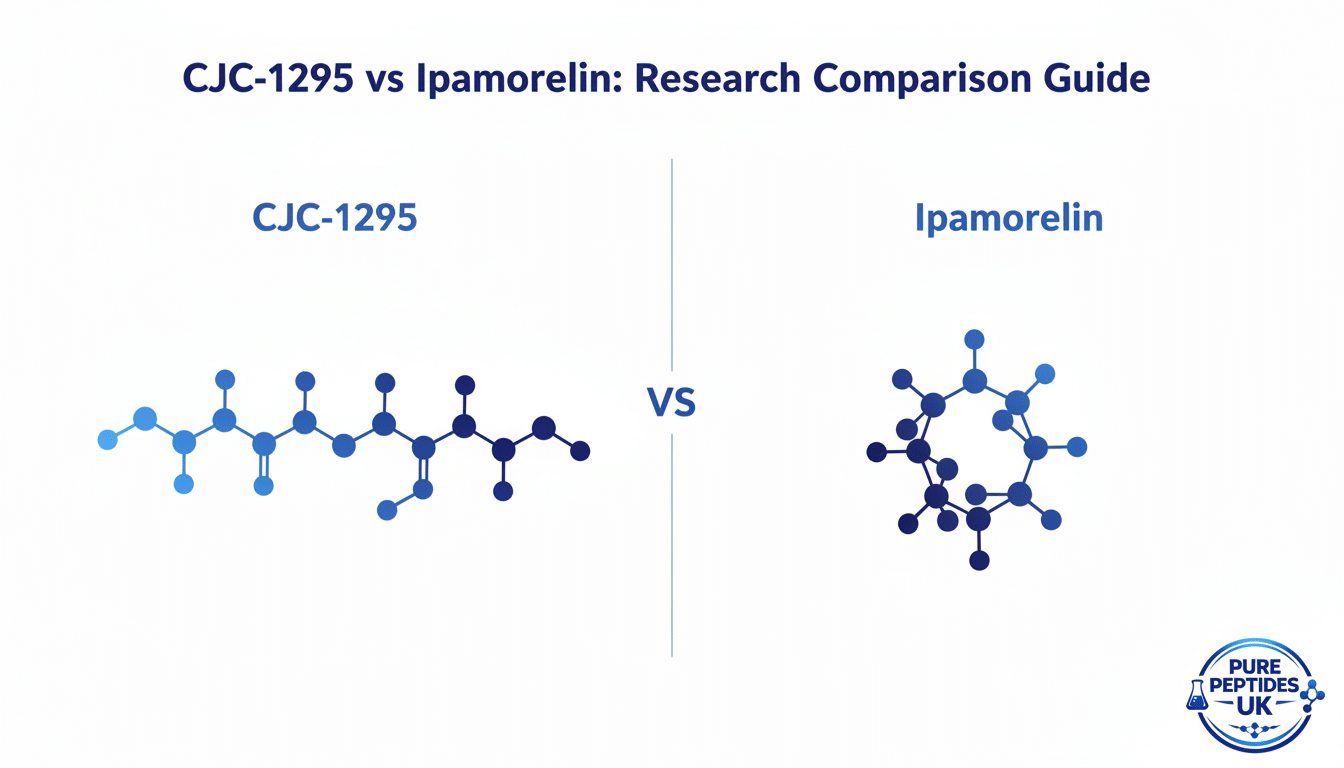
CJC-1295 and Ipamorelin are two widely studied research peptides that are often analyzed together in laboratory settings due to their interaction with growth-related signaling pathways. Within controlled research environments, these compounds are examined for how they influence hormone signaling mechanisms and receptor activity.
In the UK and globally, both peptides are commonly referenced in scientific discussions focused on peptide-based research models. While they are frequently mentioned together, their structure, mechanism, and research applications differ in several key ways.
Quick Overview
| Feature | CJC-1295 | Ipamorelin |
| Type | Synthetic peptide | Synthetic peptide |
| Research Focus | Hormone signaling pathways | Receptor-specific signaling |
| Mechanism Style | Long-acting analog | Selective receptor interaction |
| Usage | Research only | Research only |
What Is CJC-1295?
CJC-1295 is a synthetic peptide designed for research purposes, often studied for its role in signaling pathways related to growth hormone regulation. It is classified as a long-acting analog, meaning it is structured to remain stable within controlled environments for extended observation periods.
In laboratory research, CJC-1295 by pure peptides, is typically examined to understand how prolonged signaling stimulation may influence biological systems. Its extended activity makes it a useful compound for studying sustained receptor interaction over time.
Researchers are particularly interested in how such peptides behave under controlled experimental conditions, especially when analyzing long-duration signaling patterns.
What Is Ipamorelin?
Ipamorelin is another synthetic research peptide, but unlike CJC-1295, it is studied for its selective interaction with specific receptors. This targeted mechanism allows researchers to observe how focused stimulation affects signaling pathways in isolation.
In research environments, Ipamorelin is often used to explore receptor-specific responses without broader system-wide interaction. This makes it valuable for studies that aim to isolate variables and analyze precise biological responses.
Its selective nature distinguishes it from multi-pathway or long-acting peptides, offering a different perspective in laboratory investigations.
Structural Differences
One of the primary distinctions between CJC-1295 and Ipamorelin lies in their molecular structure. Each peptide is engineered with a different purpose in mind, which directly influences how it behaves in research settings.
CJC-1295 is designed with modifications that enhance its stability and extend its presence in controlled environments. This allows researchers to observe long-term interactions without rapid degradation.
Ipamorelin, on the other hand, is structured to maintain selectivity. Its design supports targeted receptor interaction, which is useful in experiments that require precision and minimal interference from other pathways.
These structural differences are central to how each peptide is applied in laboratory studies.
Mechanism of Action
In laboratory settings, CJC-1295 is studied for its ability to influence signaling pathways over an extended period. Its long-acting nature allows researchers to observe how continuous stimulation may affect system behavior under controlled conditions.
Ipamorelin is examined differently. Its mechanism is more selective, meaning it is used to study specific receptor interactions without engaging multiple pathways at once.
Researchers often compare these two peptides to better understand the contrast between sustained versus targeted signaling. This comparison helps in designing experiments where different types of receptor engagement are required.
It is important to emphasize that all findings are limited to laboratory research and controlled experimental models.

Why Are They Compared Together?
CJC-1295 and Ipamorelin are frequently compared because they represent two different approaches within peptide research. One focuses on extended interaction, while the other emphasizes selectivity.
In some experimental designs, researchers may analyze both compounds to observe how different mechanisms influence outcomes under similar conditions. This makes them a valuable pair for comparative studies.
Understanding these differences helps researchers choose the appropriate compound based on the goals of their investigation.
Research Applications in Laboratory Settings
Both CJC-1295 and Ipamorelin are studied in controlled laboratory environments where researchers analyze signaling pathways and receptor interactions. While they are sometimes referenced together, their applications in research differ based on their structural and functional properties.
CJC-1295 is typically used in studies that require prolonged observation of signaling behavior. Its extended activity allows researchers to explore how continuous stimulation may influence biological systems over time.
Ipamorelin, by contrast, is more commonly used in experiments focused on precision. Its selective receptor interaction makes it useful in studies where isolating a single pathway is essential.
These differences make both peptides valuable in research, depending on the experimental design and objectives.

Stability, Storage & Handling
Proper storage and handling are critical when working with research peptides. Both CJC-1295 and Ipamorelin require controlled laboratory conditions to maintain their structural integrity.
In research settings, peptides are typically stored at low temperatures to reduce degradation. Exposure to heat, light, or moisture can impact stability and affect experimental consistency.
Common laboratory practices include:
- Storing peptides in temperature-controlled environments
- Minimizing exposure to environmental factors
- Using sterile tools and containers during handling
CJC-1295 is often noted for its enhanced stability due to structural modifications, while Ipamorelin’s stability is maintained through careful handling and storage protocols.
Detailed Comparison Table
| Aspect | CJC-1295 | Ipamorelin |
| Structure | Modified for extended stability | Designed for receptor selectivity |
| Mechanism | Sustained signaling interaction | Targeted receptor interaction |
| Research Use | Long-duration studies | Precision-based studies |
| Stability | Higher due to structural modifications | Stable under controlled conditions |
| Research Focus | Broad pathway observation | Isolated pathway analysis |
This comparison highlights how each peptide serves a different purpose in laboratory research. Rather than one being “better,” they are used based on the needs of the experiment.

Availability in the UK
Research peptides such as CJC-1295 and Ipamorelin are typically available through specialized suppliers that focus on laboratory-grade compounds. These suppliers provide materials intended strictly for scientific research.
Pure peptides uk, offers research-focused peptides for laboratory use. As with all suppliers, it is important that products are clearly labeled for research purposes only and meet appropriate quality standards.
When sourcing peptides, researchers should prioritize:
- Transparency in product labeling
- Clear indication of research-only use
- Adherence to quality control practices
Frequently Asked Questions (FAQs)
What is the main difference between CJC-1295 and Ipamorelin?
CJC-1295 is studied for its long-acting signaling properties, while Ipamorelin is researched for its selective receptor interaction.
Are these peptides approved for human use?
No, both CJC-1295 and Ipamorelin are intended strictly for laboratory research and are not approved for human or veterinary use.
Why are they often studied together?
They are compared in research to understand the difference between sustained and targeted signaling mechanisms.
How should these peptides be stored?
They should be stored in controlled laboratory conditions, typically at low temperatures and protected from environmental exposure.
Disclaimer
All products mentioned are intended for laboratory research purposes only. They are not approved for human or veterinary use. No medical or therapeutic claims are made.